
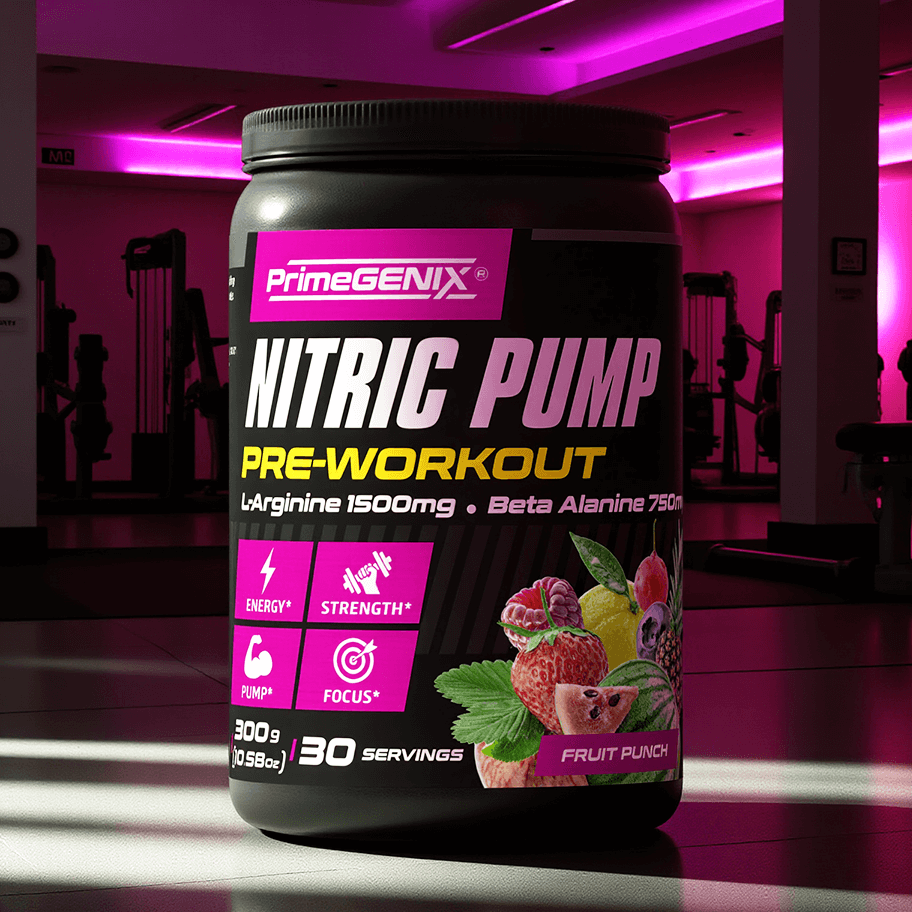
Affiliate disclosure: We sell PrimeGENIX Pre-Workout — its maker's name for it is Nitric Pump (PrimeGENIX; our score 4.0/10) — through our affiliate link and earn a commission if you buy it. It appears in this article as the cautionary example, because its maker's page performs none of the checks this page describes: despite a formula that contains caffeine, the page publishes no warnings, no exclusions and no contraindications of any kind, and never states how much caffeine a scoop delivers. Every product fact below comes from the maker's own page; the checks themselves are the standard ones any clinician would run before a stimulant-containing product at any age — they simply matter more, and are skipped more often, after 40.
Quick Answer
After 40, a pre-workout is no longer a casual purchase, for reasons that have nothing to do with fitness: blood pressure is more likely to be high — and more likely to be undiagnosed or medicated; heart history is more likely to exist; and the medication list is longer. A stimulant-containing powder taken right before maximal effort lands on all three at once. The checks are quick: know your current blood-pressure numbers, take any heart history or symptoms to a doctor before a stimulant product, review the product against your medication list with a pharmacist, and count your total daily caffeine — a step a label can make impossible. PrimeGENIX's Nitric Pump makes it impossible: caffeine is in the formula, its amount is published nowhere, every ingredient sits inside an unquantified blend, and the page carries no warning text at all. The only safety-adjacent guidance the maker offers is that beginners start with half a scoop. After 40, that is not a safety programme.
Check One: Blood Pressure — Know the Number First
The first check costs nothing and most people skip it: a recent, real blood-pressure reading. Stimulants can raise blood pressure acutely, and a hard training session raises it further by design — the combination is precisely what a pre-workout is. In your twenties, the odds that your baseline is quietly high are low. In your forties and fifties they are not, and "I feel fine" is not a measurement; hypertension's defining trait is that it usually feels like nothing. If you do not know your numbers, a pharmacy cuff or a home monitor answers it in two minutes, and the answer decides the next step: normal numbers make the remaining checks a formality; elevated numbers make the stimulant conversation a doctor's conversation, held before the first scoop rather than after the first strange heartbeat. None of this is exotic caution — it is the same logic as checking a tyre's pressure before a motorway run, applied to the organ doing the work.
Check Two: Heart History and Symptoms
The second check is a history, and it is binary. A personal history of heart disease, rhythm problems, chest pain on exertion, unexplained fainting, or a family history of early cardiac events moves any stimulant-containing product out of the self-serve category entirely — that is a cardiology question, and "the tub said nothing about it" is not a defence anyone should rely on. The same holds for symptoms that are new: palpitations that appear under training load, breathlessness out of proportion to effort, light-headedness. A pre-workout's job is to push output upward; if the system it pushes has an unresolved question mark over it, the order of operations is doctor first, supplement second — at every age, and with less room for argument each decade.
Check Three: The Medication List
By the forties, a daily medication list is normal — blood-pressure medication above all, alongside a long tail of others. The check is simply to run the product past the list, ideally with the pharmacist who fills it: stimulants and blood-pressure control pull in opposite directions; some medications and stimulant ingredients compound each other's effects on heart rate and pressure; and a blend label makes the pharmacist's job harder, because neither of you can see what is in a scoop or how much. That last point deserves emphasis. A label that prints amounts lets a professional do this check in a minute. A label like Nitric Pump's — every active inside a named matrix, quantities only in an image, caffeine dose absent altogether — turns a one-minute check into guesswork, and guesswork is what the check exists to prevent.
These statements have not been evaluated by the Food and Drug Administration. This product is not intended to diagnose, treat, cure, or prevent any disease. This article is educational and is not medical advice.
Check Four: Count the Caffeine You Can't See
The fourth check is arithmetic: total daily caffeine. Coffee in the morning, tea or an energy drink later, and then a pre-workout at 5 p.m. — each source is easy to count except the last, when the maker declines to print the dose. With Nitric Pump the position is stark. The maker lists caffeine as an ingredient, markets the product on "clean energy without the crash," and states the caffeine amount nowhere in its text — not on the label summary, not in the directions, not in the FAQ. The one tolerance instruction offered, start with half a scoop, is meaningless as a dose limit when the scoop itself is unquantified — the scoop's weight in grams is also unpublished, so half a scoop is half of an unknown amount of an undisclosed stimulant. Timing compounds it: a stimulant taken before an evening session is still working at bedtime, and sleep is the recovery variable men over 40 can least afford to spend. If a maker's position is that you do not need to know the caffeine dose, the safe reading is that the dose is the maker's convenience, not your information.
What a Responsible Label Would Have Printed
It is worth listing what is missing, because the absences are the review. A responsible stimulant-containing pre-workout aimed at adult men prints: the caffeine amount per serving, in milligrams; a maximum daily serving; warnings for pregnancy, for people with cardiovascular conditions, and for anyone on medication; and a direction to consult a doctor where those apply. The Nitric Pump page prints none of these — no caffeine warning, no maximum-dose warning, no pregnancy or medication caution anywhere in the maker's text. What it prints instead is a claim that the product will not cause jitters or a post-workout crash — a promise about the very effects its fine print should be governing. Add the page's other audit findings (sections describing a different product, "Nitric Shock™"; leftover template placeholder text; misspelled ingredient names), and the picture is of a product whose safety documentation was never really written. The product itself is inexpensive ($39 a tub, 30 servings, 67-day money-back guarantee) — but after 40, the price is not the risk. The unknowns are.
Frequently Asked Questions
Is pre-workout safe after 40?
It can be, for a healthy person with known-normal blood pressure, no heart history, a medication list that has been checked, and a label that discloses its stimulant dose. Those four conditions are the answer — a product or a person failing any one of them changes the conclusion, and the checks take minutes. What is not safe at any age is treating the absence of warnings on a label as evidence of safety.
Why does the caffeine amount matter so much?
Because it is the one ingredient whose dose decides the product's risk profile for blood pressure, heart rate and sleep — and because it stacks with every other caffeine source in your day. A printed amount lets you count; an undisclosed one, like Nitric Pump's, leaves you guessing at the single number the whole safety question turns on.
The maker says start with half a scoop. Isn't that the safety step?
It is the only safety-adjacent advice on the page, and it does not do the job: the scoop's weight is unpublished and the caffeine amount is undisclosed, so half a scoop is an unknown fraction of an unknown dose. Assessing tolerance is sensible; it is not a substitute for the blood-pressure, heart and medication checks, and it tells you nothing about interactions.
I'm on blood-pressure medication. Can I use a pre-workout?
That is a question for the doctor who prescribed it or the pharmacist who dispenses it — stimulants work against the purpose of the medication, and no supplement label can adjudicate your case. Bring the actual product; and notice that a blend label with no printed amounts gives the professional very little to adjudicate with, which is itself information about the product.
What about a stimulant-free pre-workout instead?
It removes the stimulant from the equation — the pump ingredients were never caffeine's job, as we explain in Do Non-Stimulant Pre-Workouts Actually Work? — but it does not remove the value of the checks above, and "stimulant-free" must be read on the ingredient list, not the marketing: Nitric Pump is pitched on clean energy yet contains caffeine.
The Verdict
None of the four checks in this article — pressure, heart, medication, caffeine — takes more than minutes, and after 40 each of them protects something that matters more than a workout. A label can make them easy or impossible. PrimeGENIX Pre-Workout (our score: 4.0/10) makes the central one impossible by hiding its caffeine dose, publishes no warnings for the checks it cannot make, and offers half a scoop of an unquantified blend as its entire safety apparatus. Run the checks anyway — with your own cuff, your own clinician and your own pharmacist — and let a product's willingness to print its numbers be the first test it has to pass. A maker selling stimulants to men in their forties and fifties owes them the dose. This one hasn't printed it.
Disclaimer: This article is for general information only and is not medical advice. Always consult a qualified healthcare professional before starting any supplement, especially if you have a medical condition or take prescription medication.
Last reviewed: October 2026
