
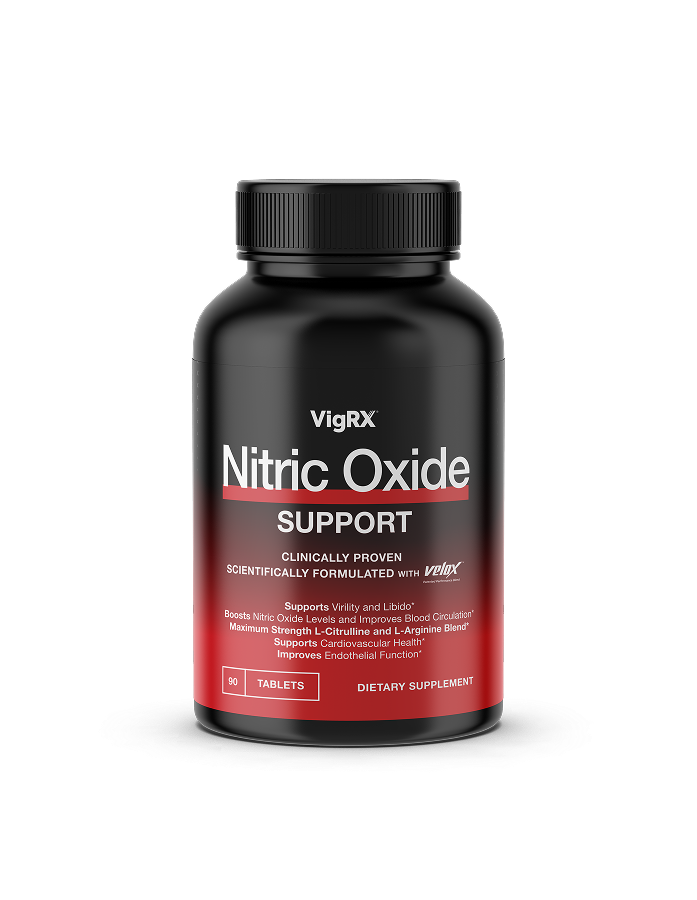
Affiliate disclosure: This article contains affiliate links. If you buy through a link on this page, we may earn a commission paid by the manufacturer, at no extra cost to you. That never changes what we publish — and on this page it means writing the sentence that costs us the sale: if you take blood pressure medication, nitrates, heart medication or a PDE5 inhibitor, do not start a nitric-oxide booster until your prescriber or pharmacist has said it is safe for you. This article is general information about why that conversation matters and what the maker of the product we sell, VigRX Nitric Oxide, does and does not publish. It is not medical advice, and it is not permission to combine anything.
Quick Answer: Why This Combination Needs a Doctor First
Because both sides of it act on the same system. Nitric oxide relaxes blood vessels — that is its job, and it is the entire selling point of nitric-oxide boosters. Blood pressure medication also works by relaxing blood vessels or reducing the force they carry, and nitrates — a standard heart medication class — work through the nitric-oxide pathway itself. When two products push blood pressure in the same direction, the question of whether their effects add up is not a marketing question; it is a prescribing question, and it can only be answered by someone who knows your medication, your doses and your readings. The maker of the product we sell publishes no warning on this subject anywhere — the sections below document that silence precisely, because it is the most important fact on this page.
The Pathway Problem, in Plain Terms
Strip the pharmacology to its shape. A nitric-oxide booster supplies L-citrulline and L-arginine, amino acids the body converts to nitric oxide; nitric oxide signals vessel walls to relax and widen. Antihypertensive medicines lower blood pressure by their own routes, several of which end at the same destination — relaxed vessels, lower pressure. Nitrates donate nitric oxide directly. PDE5 inhibitors (the Viagra family) act on the same signalling chain one step downstream. None of this means a supplement plus a medicine is automatically dangerous — supplement doses are typically far below drug doses, and for this product the dose is not even published (see below). It means the interaction question is real rather than theoretical, standard for this ingredient class, and unanswerable by a product label. The textbook proof that this pathway's interactions are taken seriously is printed on the drug side: PDE5 inhibitors carry an absolute, prominent warning against combining with nitrates, because the two together can drop blood pressure sharply. The supplement side of the same pathway deserves the same respect and receives, from this maker, none at all.
What the Maker Publishes About Safety — and What It Doesn't
Here is the complete safety record of VigRX Nitric Oxide, assembled from all three of the maker's own outlets, because no single page gives it whole. On the brand page, the FAQ answers "Are there any side effects?" with one sentence: "No side-effects have been reported." No qualification, no medication mention, no exclusion list. On the maker's retail store, the product is described as all-natural and safe for long-term use, with no side-effect section and no medication warning anywhere on the page. On the official storefront — and only there — a generic line appears: as with any supplement, consult your healthcare provider before starting if you have an existing health condition or take medications. That is the totality. Nowhere — not on the brand page, not on the storefront, not on the retail store — is there any mention of blood pressure, heart conditions, nitrates, blood-pressure medication, heart medication, or PDE5 inhibitors. And this silence sits beside an active claim: the maker lists healthy blood pressure among the product's benefits. A vasodilator marketed partly on blood-pressure benefits, with no caution for the men already medicated for blood pressure — who are, demographically, among its likeliest buyers. Our review scores this product's safety documentation 4.0/10, the lowest sub-score in its audit, almost entirely for this gap.
The Ingredient-Dose Problem Makes It Worse
Even a buyer who does everything right — takes the product name to his pharmacist and asks — hits a wall the maker built. VigRX Nitric Oxide publishes no amount for its Velox® blend or for either amino acid, and no Supplement Facts panel appears on any maker page. The blend's supplier specification suggests the effective level is around 1.2 g of L-citrulline plus 1.2 g of L-arginine, but whether this product delivers that, more, or a fraction of it is not published anywhere. So the interaction conversation cannot even be quantified: a clinician asked "is this safe with my medication?" is being asked about an unstated dose of two vasodilating amino acids. "Unverifiable" is not the same as "strong" — three tablets may well contain modest amounts — but safety decisions are not made on "may well." They are made on numbers, and this maker declines to provide them.
These statements have not been evaluated by the Food and Drug Administration. This product is not intended to diagnose, treat, cure, or prevent any disease.
The Checks to Run Before Combining Anything
General information only — the sequence a cautious buyer follows, in order:
- Ask the prescriber or pharmacist first, by name. Bring the product's name and its two ingredients (L-citrulline, L-arginine). "A nitric-oxide booster" is a category; your clinician needs the actual product. If the answer is no, the answer is no — the 67-day guarantee on a $59 bottle is not a counter-argument.
- Never adjust prescribed medication to make room for a supplement. Do not skip, halve or reschedule blood pressure, heart or any other prescribed medicine in order to take a booster, and do not stop a prescribed medicine because a supplement claims the same benefit. Any change to prescribed treatment is the prescriber's call, full stop.
- Treat new symptoms as information. Dizziness, light-headedness, faintness, a racing or pounding heartbeat, or unusual headaches after starting any new product are reasons to stop the new product and seek medical advice promptly — urgently if you feel faint. This is standard advice for anything that touches blood pressure, and it applies whether or not a maker prints it.
- Apply the same rule to the whole pathway. The question is not only about this brand. Any nitric-oxide booster, pre-workout with citrulline or arginine at gram doses, or beetroot-concentrate product raises the same conversation for a medicated reader — and the larger and more clearly labelled the dose, the more seriously the conversation should be taken.
Frequently Asked Questions
My blood pressure is well controlled on medication. Does that change the answer?
It changes the conversation, not who has it. Controlled readings are exactly what medication is achieving; whether adding a vasodilating supplement is acceptable in your case depends on your specific medicines and doses. That is a prescriber question with a definite answer — ask it and take the answer.
The maker says no side effects have been reported. Isn't that reassurance?
No. "No side-effects have been reported" is a statement about the maker's reporting, not a result from interaction testing. Supplements are not put through the drug-interaction trials prescription medicines undergo, and this maker publishes no warnings section in which an interaction could even be recorded. Absence of a published warning is an absence of data — here, documented above in the maker's own words.
What about combining a nitric-oxide booster with Viagra-type medication?
Same rule, same reason: same pathway, one step apart. PDE5 inhibitors carry strict printed warnings about nitrates; a nitric-oxide booster carries no printed warnings at all. Whether the combination is acceptable for you is your prescriber's decision — never a supplement page's, including this one.
The Bottom Line
The product itself may be unremarkable — two ordinary amino acids in an unpublished amount. The paperwork is the problem: a maker that claims blood-pressure benefits, answers the side-effects question with "none reported," and prints no interaction warning of any kind on the pages where buyers actually decide. VigRX Nitric Oxide scores 5.5/10 in our review, with safety at 4.0/10, largely for this silence. If you are unmedicated and healthy, that silence is a documentation failure. If you take blood pressure, heart or nitrate medication or a PDE5 inhibitor, treat it as the answer to a different question — not "is this safe for me?" but "has this maker done the work to tell me?" It has not. Your prescriber is the only route to the first answer.
Disclaimer: This article is for general information only and is not medical advice. It does not assess any individual's medication or condition. Always consult a qualified healthcare professional — your prescriber or pharmacist — before starting, combining or stopping any supplement or medicine.
Last reviewed: October 2026
