
- Quick Answer: Which Levers Actually Move Semen Volume?
- What Is a Normal Semen Volume?
- Does Drinking More Water Really Increase Semen Volume?
- How Much Does Ejaculation Timing Matter?
- Which Nutrients Are Linked to Semen Production?
- Which Habits Quietly Reduce Volume?
- Do Semen Volume Supplements Work?
- When Is Low Volume a Reason to See a Doctor?
Affiliate disclosure: This article contains affiliate links. If you buy through a link on this page, we may earn a commission from the manufacturer at no extra cost to you. That does not decide what we say here: where the evidence is thin, we say so.
If you have been searching for how to increase semen volume naturally, you have probably already met the exaggerated version of this topic — dramatic promises and supplements presented as guaranteed fixes. This guide takes the honest route. Semen volume is mostly a plumbing and lifestyle matter: the glands that produce seminal fluid respond to hydration, ejaculation frequency, nutrition, and daily habits. Some levers genuinely move the needle; others, despite the marketing, do very little.
One clarification first: semen volume is not the same as fertility. Sperm make up only a small fraction of ejaculate fluid — most of the volume comes from the seminal vesicles and the prostate. Fertility depends far more on sperm count, motility (how well sperm swim), and morphology (their shape). A man can have modest volume and excellent fertility, or generous volume and poor sperm quality. Increasing volume is a legitimate goal — many men link it to stronger orgasms — but treat it as a comfort goal, not a fertility shortcut. If conception is the real concern, a semen analysis tells you more than any volume tip.
Quick Answer: Which Levers Actually Move Semen Volume?
The short version, in order of reliability:
- Hydration. Semen is mostly water. Chronic under-hydration can reduce fluid output; drinking enough restores your baseline.
- Ejaculation timing. Spacing ejaculations by two to three days noticeably increases per-ejaculate volume; daily ejaculation lowers it. The most predictable effect on this list.
- Nutrients. Zinc, certain amino acids, and a few other nutrients are genuinely involved in semen production. Correcting a deficiency helps; megadosing is not proven to.
- Habits. Smoking, heavy drinking, heat exposure to the groin, and poor sleep are all associated with worse semen parameters, volume included.
Not on this list: any food or product that reliably multiplies volume several times over. Claims of that size are marketing, not physiology.
What Is a Normal Semen Volume?
The World Health Organization (WHO), whose laboratory manual is the reference standard for semen analysis, sets 1.5 millilitres (mL) as the lower reference limit for ejaculate volume. A typical ejaculate falls around 1.5 to 5 mL — roughly a third of a teaspoon to a full teaspoon. Clinics generally treat volume consistently below 1.5 mL as low (the clinical term is hypospermia) and worth investigating.
Two things surprise most men. First, volume fluctuates naturally — hydration, arousal, time since the last ejaculation, and stress all shift the number, which is why clinics ask for two samples. Second, sperm are a tiny share of that fluid: the seminal vesicles contribute the largest portion (including fructose, the fuel for sperm), the prostate adds another share, and the testes' contribution by volume is small. So most natural volume strategies support those glands and their fluids, rather than "making more sperm."
Does Drinking More Water Really Increase Semen Volume?
Yes — with a qualification. Because seminal fluid is mostly water, a dehydrated body produces less of it, and restoring normal intake brings volume back up. But it works by correcting a deficit, not by pushing you past your natural ceiling: once you are properly hydrated, extra water adds nothing — the glands produce at their own rate and the surplus leaves as urine. Think of hydration as removing a brake rather than pressing an accelerator: drink steadily through the day, use pale-yellow urine as a rough gauge, and pay extra attention on hot days, after exercise, and after alcohol.
How Much Does Ejaculation Timing Matter?
More than most men expect. The seminal vesicles and prostate refill over time, so the interval since your last ejaculation directly affects how much fluid is available. Ejaculating daily reliably produces smaller volumes; waiting two to three days lets the glands replenish and typically produces a visibly larger ejaculate. Fertility clinics ask for two to five days of abstinence before a semen analysis for exactly this reason.
The effect plateaus, though: beyond roughly three to five days the reservoirs are full, and very long abstinence can work against sperm quality, since stored sperm age. So two to three days is the sweet spot — and timing is the fastest lever here.
Which Nutrients Are Linked to Semen Production?
Nutrition is where this topic gets flooded with hype, so be careful about the standard of proof. What follows is ingredient-level evidence: nutrients with plausible roles in semen production and, in some cases, supporting research on semen parameters. That is not proof that any particular pill raises volume — the supplements section explains the difference.
- Zinc. The prostate concentrates zinc, and seminal fluid contains meaningful amounts of it. Deficiency is associated with poorer semen quality, and zinc also plays a role in testosterone metabolism. Men who eat little meat, seafood, or dairy are most likely to run low.
- L-Arginine. An amino acid involved in nitric oxide production and blood flow, studied in relation to sperm count and motility. Evidence for volume specifically is indirect.
- L-Carnitine. Concentrated in the epididymis, where sperm mature, and studied mainly for motility. Volume effects are inferred, not directly demonstrated.
- L-Lysine. Often paired with zinc in volume formulas, on the theory that the combination supports zinc uptake and gland function. Standalone evidence for volume is limited.
- Antioxidants such as vitamin E. Sperm and the surrounding glands are vulnerable to oxidative stress — one reason smoking does damage. Antioxidant intake from food is associated with better semen parameters; supplement trials are mixed.
The pattern: these nutrients support the machinery — glands, blood flow, sperm maturation — rather than acting like a tap you can open wider.
Which Habits Quietly Reduce Volume?
Sometimes the fastest way to increase volume is to stop suppressing it. Several common habits are associated with reduced semen volume or poorer semen quality in public health research:
- Smoking. Consistently linked to worse semen parameters, including lower volume and count, plausibly through oxidative stress.
- Heavy alcohol use. Regular heavy drinking interferes with testosterone production and dehydrates you at the same time. Chronic excess is the problem; moderate intake is less clearly harmful.
- Heat exposure. The testes work best slightly below body temperature. Frequent hot tubs, saunas, long hot baths, heated seats, and laptops on the lap are associated with suppressed production.
- Poor sleep. Testosterone is produced largely during sleep, and short or disrupted sleep is linked to lower testosterone and worse semen quality.
- Certain medications and substances. Some prescription drugs, anabolic steroids, and recreational drugs can reduce volume or shut down sperm production. Never stop a prescribed medication over this concern — raise it with the doctor instead.
No single change is dramatic, and none works overnight. But a man who smokes, drinks heavily, and sleeps badly has several brakes pressed at once — releasing two or three beats any single product.
Timing matters here too: if you are wondering how long male enhancement supplements generally take to show results, see our guide How Long Do Male Enhancement Supplements Take to Work? An Honest Timeline.
Do Semen Volume Supplements Work?
Separate three questions that marketing usually blurs together. First: do the ingredients have evidence? Some do — at the ingredient level, for semen health broadly. Second: does a specific finished product have evidence? That requires the actual formula, at its actual doses, to be tested — a higher bar most brands never attempt. Third: does "clinically studied" on a label mean a product is proven to work for you? It does not. It means a study exists; who funded it and whether results were independently replicated matter.
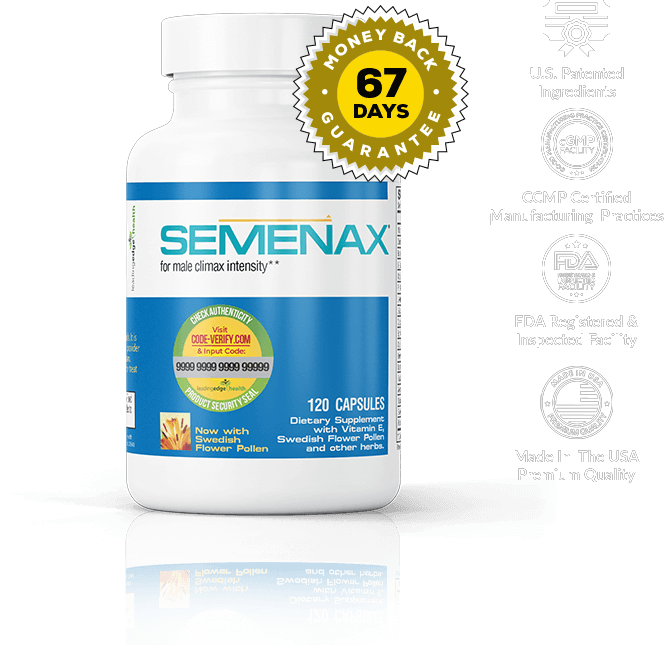
The best-known product in this category is Semenax, a volume formula from Leading Edge Health built around the nutrient pattern above — zinc, L-arginine, L-carnitine, L-lysine, Swedish flower pollen and others. According to the maker, Semenax has been through a clinical study of its own: the company describes a double-blind, placebo-controlled study conducted over about two months. That is the right kind of design, and the two-month window reflects how these formulas are used: daily, with effects that build over time. But read the claim at the right strength. It is the maker's own description of a study connected to its product — not broad independent confirmation, and not a guarantee of any individual's result.
The other formula we carry, Volume Pills, takes the same general approach — herbal and nutrient support for the glands that produce seminal fluid — without the same clinical-study positioning. For either, set expectations correctly: supplements here support the foundations above, not replace them. Combine one with hydration, sensible timing, and the habit fixes, give it the full trial period the makers describe, and judge it on your own results — the major brands here offer money-back guarantees (Semenax's is 67 days) so that judgement is not a gamble.
These statements have not been evaluated by the Food and Drug Administration. These products are not intended to diagnose, treat, cure, or prevent any disease.
When Is Low Volume a Reason to See a Doctor?
Most low volume is lifestyle and plumbing, not disease. But some patterns deserve a medical look — a companion post will go deeper. See a doctor or urologist if you notice:
- Consistently very low volume — well under the WHO's 1.5 mL reference point on multiple occasions.
- A sudden change — volume that drops sharply or disappears, which can signal a blockage, infection, or a new medication's effect.
- Very little fluid with cloudy urine afterwards — a pattern associated with retrograde ejaculation, where semen flows into the bladder. It is linked to diabetes, some medications, and prostate procedures, and is often treatable.
- Blood in the semen, pain, or burning — these point to infection or inflammation, not a supplement deficiency.
- A year of trying to conceive without success (six months if your partner is over 35). A semen analysis — measuring volume alongside count, motility, and morphology — is then the right next step.
None of this is meant to alarm: lifestyle levers and supplements serve the broad middle of men who are simply at the lower end of normal. Outside that middle, a clinician is the right call.
The bottom line: increasing semen volume naturally is mostly unglamorous — hydrate properly, space ejaculations by two to three days, cover the key nutrients, and release the habit brakes. If you want structured support on top of that, our two formulas are set out on their product pages, merchant-stated evidence included: Buy from Official Website for Semenax's details and study description, and the Volume Pills page for its formula and guarantee terms.
This article is educational and is not medical advice. Dietary supplements are not evaluated by the FDA for efficacy, and individual results vary. Consult a qualified healthcare professional about any persistent change in semen volume or sexual health.
Last reviewed: October 2026
