
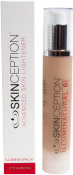
Affiliate disclosure: This article contains affiliate links. If you buy through a link on this page, we may earn a commission paid by the manufacturer, at no extra cost to you. That never changes what we publish — and here it means starting with the part no serum advertisement leads with: dark spots fade at the speed of your skin's own renewal cycle, not at the speed of a marketing promise. The one product this store sells for the job, Illuminatural6i, is examined against that standard below — including the two documentation problems on its maker's own site.
Dark spots are, at bottom, a pigment problem. The maker of Illuminatural6i frames its target list as marks "caused by excess deposits of melanin": freckles, sun and age spots, acne scars, melasma, birth marks and post-inflammatory marks left behind after skin has been irritated or injured. That framing is useful because it tells you what "fading" has to mean. A spot is not a stain sitting on top of the skin that can be wiped off. It is pigmented cells, in skin that replaces itself on a cycle. Anything that genuinely fades a spot works with that cycle — slowing new pigment production while the pigmented cells already there are gradually shed and replaced. Anything promising to beat that cycle is promising something skin does not do.
Quick Answer: What Actually Fades Dark Spots?
Three things, working together over weeks: a brightening routine applied consistently (the products in this category are used twice daily, and consistency is the variable buyers control most), protection from the sun exposure that creates and re-darkens pigment, and time measured in skin cycles — the maker of the serum we sell puts first visible results at about four weeks, nothing worth judging before one full 28-day cycle, and best results at around 90 days. What does not fade spots: one-off treatments applied sporadically, overnight products, and picking at the skin, which creates fresh post-inflammatory marks of exactly the kind you are trying to remove.
Why the 28-Day Cycle Decides Everything
Skin renews itself from below. New cells form at the base and rise to the surface over roughly a month — the maker describes its serum as working "with your body's normal 28 day skin regeneration process," and its stated mechanism follows that logic: reduce melanin production, help new, lighter skin cells rise to the surface, slough off dead, pigmented cells, and support the regeneration cycle. Each pass of that cycle, if less new pigment is being produced and the surface keeps turning over, the mark should read lighter than the pass before.
This is why the honest timeline in this category is quoted in cycles, not days. The maker itself warns that any company or "professional" who promises results in less than 30 days "should be looked at with a VERY critical eye" — a standard we are happy to hold the whole shelf to, including this product. First results "beginning in just 4 weeks" is the maker's claim; the same maker sets best results at three cycles, roughly 90 days of twice-daily use. A routine judged at day 10 has not failed. It has barely started.
The Routine Itself: What Twice-Daily Actually Means
For the serum this store sells, the maker's directions are specific: apply in small dots to the areas you wish to lighten, smooth gently until absorbed, twice daily — morning and evening — on face or body, and it can be worn under makeup. That rhythm matters more than any single ingredient, because the mechanism is cumulative: each application is a small nudge to pigment production, and the visible result is the sum of roughly 180 applications over a 90-day course. Skipping days does not pause the clock so much as weaken the nudge.
Two disciplines separate the people who see change from the people who write angry reviews at week three. The first is sun protection. Ultraviolet light is what triggers much of the pigment you are trying to fade, and new exposure re-darkens marks faster than a serum lightens them; a morning application followed by unprotected midday sun is one step forward and one back. Note, because we flag gaps wherever they sit: the maker publishes no sunscreen guidance on its pages for this daylight-use lightening product. That advice is missing from its paperwork, not from what your skin needs. The second discipline is photographs. Change this gradual is invisible in a daily mirror check. Take a photo in the same light on day one, and compare at the end of each cycle — day 28, day 56, day 84. Your eyes will lie to you; the photos will not.
What to Look for in a Brightening Product
The current formula of Illuminatural6i, as published on the maker's homepage, is built on three recognisable brightening actives — sodium ascorbyl phosphate (a vitamin C derivative), niacinamide (vitamin B3) and kojic dipalmitate (a kojic acid form) — in a base of shea butter, aloe, chamomile and green tea. Those are sensible names for the job. What the maker does not publish is any concentration for any of them, and in this category the percentage is not a detail: the same ingredient at a token level and at a studied level is two different products wearing one label. Our buying guide to dark-spot ingredients works through each of the four headline ingredients in this category — niacinamide, alpha-arbutin, vitamin C and kojic acid — and what a label can and cannot tell you about each.
Then the two flags this product carries, stated plainly because they shape what its evidence is worth. First, the maker's own site publishes two incompatible formulas: the homepage list above, and an older list — still live on the maker's FAQ and formulation pages — built on sodium lactate, magnesium ascorbyl phosphate, Whitonyl and alpha-arbutin, with percentages. Second, every study the maker cites belongs to that older formula. The niacinamide figures, the alpha-arbutin comparisons, the Whitonyl data: ingredient-level research, attached to ingredients the current homepage formula does not contain. None of it is evidence for the product in the current pump, and we do not present it as any. What the current formula has behind it is three credible ingredient names, no published amounts, and the maker's timeline. Judge it on that basis, not on borrowed studies.
What Will Not Work, Whatever the Label Says
Treating the spot while feeding its cause. Sun exposure, picking at healing skin, and harsh scrubbing all generate new pigment or new post-inflammatory marks. No serum outruns its user's habits. Judging inside one cycle. The mechanism needs surface turnover; a verdict at two weeks is a verdict on your moisturiser, not on fading. Expecting a cosmetic to do a clinician's job. A brightening serum addresses the appearance of pigmented marks. A mark that is new, changing, irregular or growing is not a cosmetic problem at all — it needs a doctor's eyes before it needs a serum, and our guide to telling dark spots, acne marks and melasma apart sets out those warning signs in full. And using a lightener on active acne: the maker itself limits this product to acne scars, and does not recommend it for treating acne itself.
These statements have not been evaluated by the Food and Drug Administration. This product is not intended to diagnose, treat, cure, or prevent any disease. This article is educational and is not medical advice.
The Bottom Line
Getting rid of dark spots on your face is a real, achievable goal — at cycle speed. A twice-daily brightening routine, genuine sun discipline, and a 90-day judging window are what actually fades them; everything else is decoration. Illuminatural6i (our score: 6.1/10) fits that routine honestly in one respect — its maker states the 28-day and 90-day timelines plainly — and falls short in two others: no concentrations for its current formula, and a research file that belongs to a different, older version of the product. Buy it, if you buy it, knowing exactly that. Readers whose concern is overall skin aging rather than pigmentation specifically are in a different category altogether — that is the territory of GenF20 Plus, the anti-aging system we review separately.
Disclaimer: This article is for general information only and is not medical advice. Always consult a qualified healthcare professional about any skin concern, especially a mark that is new, changing or irregular. Individual results vary, and no result is guaranteed.
Last reviewed: October 2026
