
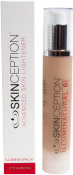
Affiliate disclosure: This article contains affiliate links. If you buy through a link on this page, we may earn a commission paid by the manufacturer, at no extra cost to you. That never changes what we publish — and here it means defending a timeline that sells nothing quickly: the maker of the one dark-spot serum this store sells, Illuminatural6i, states its own timeline with unusual honesty, and this page holds the whole category to it — including the awkward gap between that timeline and the same maker's guarantee.
Almost every disappointment in this category is a calendar problem, not a product problem. A buyer applies a brightening serum for ten days, sees a spot that looks exactly as it did, and concludes the product failed. The maker of this one anticipated that buyer. Its pages state that results begin "in just 4 weeks," that nothing should be judged before one full cycle of skin regeneration, and that best results arrive after about three cycles. It also prints the sharpest sentence in the category: any company or "professional" who promises you results in less than 30 days "should be looked at with a VERY critical eye." This page explains why that timeline is what it is — and where your money's deadline sits inside it.
Quick Answer: How Long Do Dark Spots Take to Fade?
For a topical brightening routine used twice daily: first visible change at around 4 weeks (one skin cycle), a fair judgement at 8 weeks (two cycles), and the maker's own best-results point at roughly 90 days (three cycles). Deeper or older pigmentation runs longer; marks still being fed by sun exposure or fresh inflammation may not fade on any schedule until the cause stops. Anything promising you a verdict inside a month is promising it before the first layer of renewed skin has even reached the surface.
The 28-Day Cycle: What the Clock Actually Is
Your skin is not a static surface; it is a conveyor. New cells are produced at the base of the epidermis and migrate upward, flattening and shedding as they go — a journey of roughly 28 days in younger adults, and slower with age. A dark spot lives in that conveyor: pigment deposited in cells that are already travelling. Fading, mechanically, is two things happening across successive cycles — less new melanin being produced in the fresh cells, and the pigmented cells ahead of them completing their journey and leaving.
The maker describes its serum's mechanism in exactly these terms: interrupt and reduce melanin production, help new lighter cells rise to the surface, slough off the dead pigmented cells, and support the normal 28-day regeneration cycle. That is why one cycle is the minimum unit of judgement. At day 14 you are looking, almost literally, at the same surface cells you started with. The earliest honest checkpoint is the end of the first full cycle — which is why the maker's "beginning in just 4 weeks" and its warning against sub-30-day promises are the same statement read from two directions.
The 90-Day Reality: Why Makers Judge at Three Cycles
If one cycle shows the first change, why does the maker's own material point to three? Because the first cycle's improvement is the shallowest version of the result. Pigment is not distributed evenly through the skin's layers, and the production slowdown a brightener causes compounds across cycles: the cells surfacing at day 60 were formed under a longer period of reduced pigment production than the cells that surfaced at day 28. The maker's FAQ accordingly tells buyers to try the product for 90 days — three containers' worth, by its own arithmetic of roughly one pump per month — for the full picture.
Two variables stretch or compress that schedule, and both are partly in your hands. Consistency: the directed use is twice daily, morning and evening; a cycle of sporadic application is a weaker intervention than the timeline assumes. Exposure: ultraviolet light restimulates pigment production, so unprotected sun during the course works directly against it — and it is worth noting that the maker publishes no sunscreen guidance on its pages, a gap in its paperwork that does not change the biology. Add the fixed variables — older, deeper sun spots fade slower than recent acne marks; the cycle itself lengthens with age — and "about 90 days, judged in cycles" is the honest centre of the range.
The Deadline Inside the Timeline: 67 Days
Now the part that decides purchases. The maker calls this product's guarantee 90 days on some of its pages — and enforces 67 days from delivery in the return terms printed in its own FAQ: returns must be received back within 67 days of delivery, with no exceptions, for a full refund excluding shipping. Both numbers are the maker's. They cannot both govern your money, and the one with terms attached is the 67-day figure.
Set that against the timeline above and the practical problem is exact: the maker recommends a 90-day course, and its enforceable refund window closes at day 67 — before the course it recommends is finished. You cannot complete the full trial and keep the refund. What you can do is judge intelligently inside the window: the 90-day course is three cycles, and the guarantee covers the first two and a third. Photograph the marks in consistent light on day one, compare at day 28 and again at day 56, and make the keep-or-return decision on that two-cycle evidence — a visible trajectory by then is the meaningful signal; complete absence of any change across two full cycles is also meaningful, and it arrives in time to act on. Buyers who drift to day 70 before deciding have, in practice, decided.
Frequently Asked Questions
Can dark spots fade faster — in a week or two? Not by the mechanism any topical brightener uses. Surface hydration can make skin look briefly brighter, but pigmented cells leave on the renewal cycle, and no maker claim we would print promises otherwise. The maker of this product explicitly warns against sub-30-day promises.
Why did my spot look lighter, then darker again? Usually exposure. Sunlight restimulates pigment production, and a few unprotected days can darken a mark that weeks of routine had lightened. It is the most common reason a course appears to stall or reverse — and the reason sun protection is part of the treatment, not an accessory to it.
Does the timeline differ by skin tone? The maker states the product works equally well for all skin tones. What does vary is the mark, not the marketing: post-inflammatory marks on deeper skin tones are often more pronounced and slower to clear, which argues for judging at the longer end of the cycle range rather than the shorter.
What if nothing has changed after 90 days? Then the honest readings are that the pigmentation sits deeper than a cosmetic reaches, that its cause (sun, hormones, ongoing inflammation) is still active, or that the mark is something other than ordinary pigmentation. Each of those is a reason to stop buying pumps and consult a dermatologist — not to start a fourth container.
These statements have not been evaluated by the Food and Drug Administration. This product is not intended to diagnose, treat, cure, or prevent any disease. This article is educational and is not medical advice.
The Bottom Line
Dark spots fade on a 28-day clock, are judged fairly at two cycles, and show their best topical result around 90 days. Illuminatural6i (our score: 6.1/10) earns credit for printing that timeline plainly — and loses some for a guarantee whose enforceable 67-day deadline expires before its own recommended course ends. Plan around both numbers: start the course the day the pump arrives, photograph at each cycle, and make your decision by day 56 rather than discovering the deadline at day 70.
Disclaimer: This article is for general information only and is not medical advice. Always consult a qualified healthcare professional about any skin concern, especially a mark that is new, changing or irregular. Individual results vary, and no result is guaranteed.
Last reviewed: October 2026
