
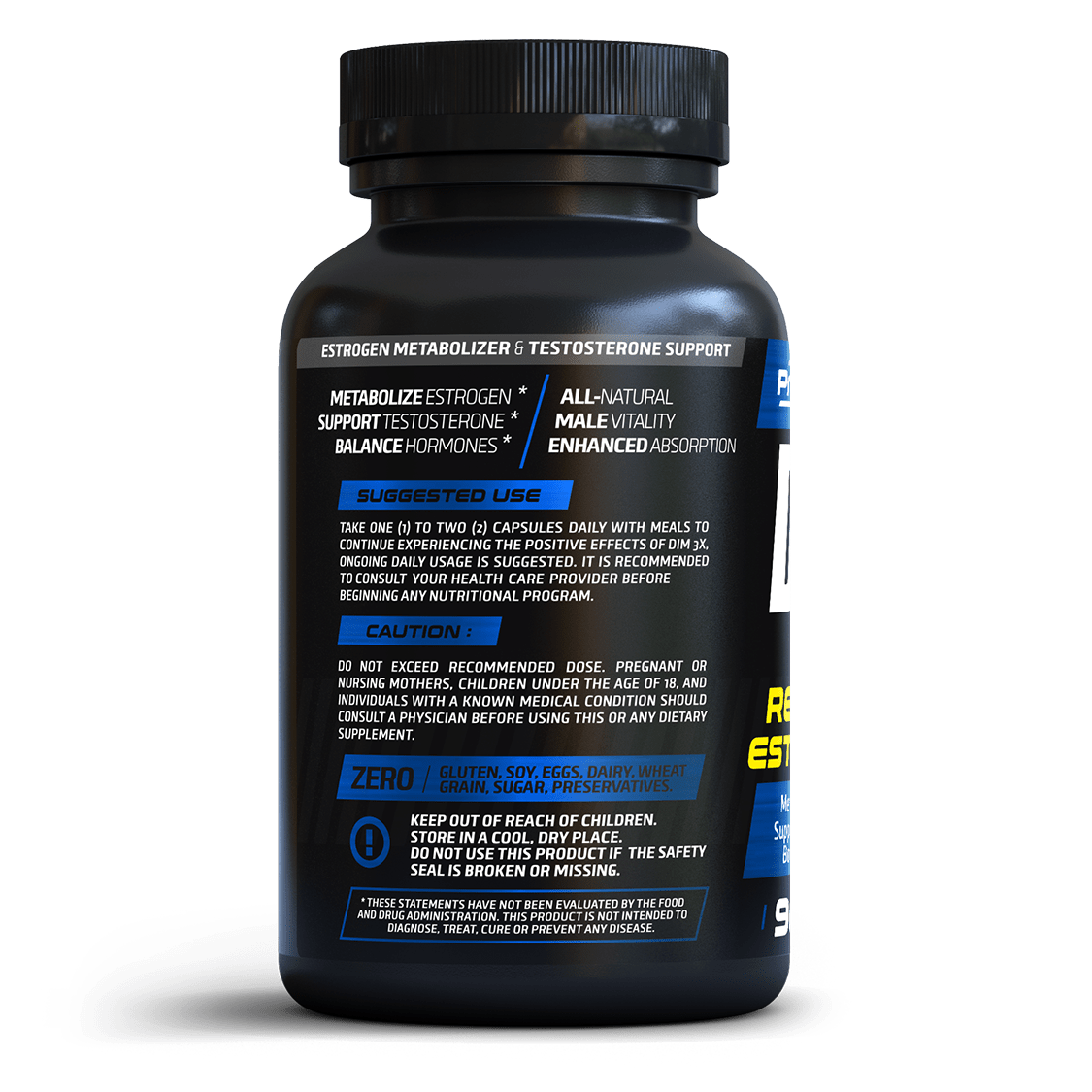
Affiliate disclosure: This article contains affiliate links. If you buy through a link on this page, we may earn a commission paid by the manufacturer, at no extra cost to you. That never changes what we publish — and here it means answering the headline question in its least marketable form. The DIM product we sell, DIM3X, is not claimed even by its own maker to raise testosterone directly. Its pitch is an indirect chain about estrogen. This page takes that chain apart link by link, attributes every link to the maker who states it, and then asks the only question that settles such claims: was testosterone ever measured?
Quick Answer: Does DIM Raise Testosterone?
There is no published evidence — in anything the maker of DIM3X puts on its page — that DIM raises testosterone. The claim structure is indirect, in three parts, all of them the maker's: DIM is said to shift estrogen metabolism from one metabolite to another, to inhibit the aromatase enzyme that converts testosterone to estrogen, and the formula's Vitamin E is presented as supporting testosterone production. "Supports healthy testosterone production" is the maker's actual wording, and it is a different claim from "raises testosterone levels." No trial of the finished DIM3X product is described on the maker's page, no study of any kind is named or cited there, and no testosterone measurement appears anywhere in the evidence the maker offers. Men whose testosterone is being managed medically — on TRT or being assessed for it — should treat this whole category as a clinician conversation, not a substitute for one.
The Claim Chain, Link by Link
Link one: the metabolite shift. PrimeGENIX says DIM helps convert what it calls "bad estrogen" — 16-alpha-hydroxyestrone — into "good estrogen" metabolites, 2-hydroxyestrone. Note the framing: "bad" and "good" are the maker's words for two estrogen metabolites, and the claimed action is about the ratio between estrogen by-products. Nothing in this link touches testosterone production at all. It is an estrogen-metabolism claim, and the leap from it to "therefore testosterone rises" is made by marketing adjacency, not by anything the maker states.
Link two: aromatase. The maker says DIM inhibits the aromatase enzyme, so testosterone converts less to estrogen. This is the link that does the real work in the pitch, because it at least points at testosterone — by conservation rather than production: block a drain, the argument runs, and the level holds higher. Stated as the maker's mechanism, that is a coherent story. What the maker's page does not provide is any measurement behind it: no study is named for the aromatase claim, no conversion rate is quantified, and no before-and-after testosterone figure appears. A mechanism story is a hypothesis about what an ingredient is intended to do. It is not a result.
Link three: Vitamin E. The maker presents Vitamin E as the formula's testosterone-production support, and quantifies it only as "134% of the daily value" per dose — the milligram amount is not published. So the one ingredient in the formula explicitly tied to testosterone production is the one whose dose a buyer cannot read. Whatever Vitamin E's role, this page cannot tell you how much of it DIM3X delivers, because the maker does not say.
What the Evidence File Actually Contains
Set the chain down and audit what stands under it. The maker calls DIM3X "clinically dosed with 200 mg of high-quality DIM" and states that "this dosage has been used successfully in human clinical studies." That sentence is the strongest evidence language on the page, and it names no study — no citation, no link, no design, no participants, no sponsor, and no endpoint. A reader cannot tell from the maker's page what those studies measured, in whom, or whether testosterone was among the measurements. The supporting ingredients are documented the same way: AstraGin® is "backed by 24 studies" (unnamed), and "clinical studies show BioPerine® can help absorption by 30% to 60%" (unnamed). And the decisive absence: no trial of the finished DIM3X product is described at all. The formula a buyer actually swallows — 200 mg DIM plus Vitamin E, AstraGin® and BioPerine®, one capsule a day with meals — has never, on the maker's own published account, been put through a study whose results a reader can inspect.
These statements have not been evaluated by the Food and Drug Administration. This product is not intended to diagnose, treat, cure, or prevent any disease. This article is educational and is not medical advice.
"Supports" Is Not "Raises": The Wording That Matters
Supplement labels live in the gap between those two verbs. "Supports healthy testosterone production" — the maker's phrasing for DIM3X, alongside "supports testosterone" in its benefits list — is a structure-and-function claim: it describes an intended role, and it is the language of the entire category. "Raises testosterone by X" would be a measurement claim, and it would require a trial that measured testosterone. DIM3X's page contains the first kind of language throughout and the second kind nowhere. That is not a technicality; it is the answer to this article's question in the maker's own words. The claimed benefits around the core claim — metabolise estrogen, inhibit aromatase, increase strength and stamina, improve focus, mood and concentration — are likewise presented as the formula's intended effects, not as outcomes from a study of the product. Our review scores DIM3X's evidence at 5.5/10 for exactly this reason: ingredient-level assertions, an unnamed "clinically dosed" anchor, and no finished-product data.
What Would Settle the Question
The experiment that answers "does DIM raise testosterone?" is not exotic: a controlled trial of the finished formula, in the men the product is sold to (the maker targets men 40 and over), measuring testosterone before and after against placebo, published with its design and numbers visible. Nothing like it is described on the maker's page. Until something like it exists, every honest version of the answer has the same shape: the mechanism story is the maker's, the metabolite framing is the maker's, the Vitamin E dose is unpublished, and the testosterone measurement does not exist in the published file. A reader who wants to know his testosterone level has a direct route to that information — a blood test, arranged through a clinician — which no capsule label can substitute for. Men already on testosterone therapy, or being worked up for it, should route any DIM question to the prescribing clinician; this category's paperwork is not built to be combined with prescribed hormone management, and DIM3X's maker publishes no TRT guidance at all.
The Bottom Line
Does DIM raise testosterone? On the published evidence: not shown. What is shown — all of it maker-stated — is an estrogen-metabolism positioning, an aromatase story, and a "supports production" claim resting on an ingredient whose dose is not printed. DIM3X (Our Score 6.5/10) does one thing unusually well for this category — it prints its headline DIM dose, 200 mg, plainly — and our review credits that while scoring the evidence file as it stands. Buy it, if you buy it, as an estrogen-balance formula with an unverified downstream hope attached, not as a testosterone product. Readers comparing the same maker's direct testosterone positioning can read our PrimeGENIX Testodren review next — and apply the same measurement standard there.
Disclaimer: This article is for general information only and is not medical advice. Always consult a qualified healthcare professional before starting any supplement, especially if you have a medical condition, take prescription medication, or are on or being assessed for testosterone therapy.
Last reviewed: October 2026
