
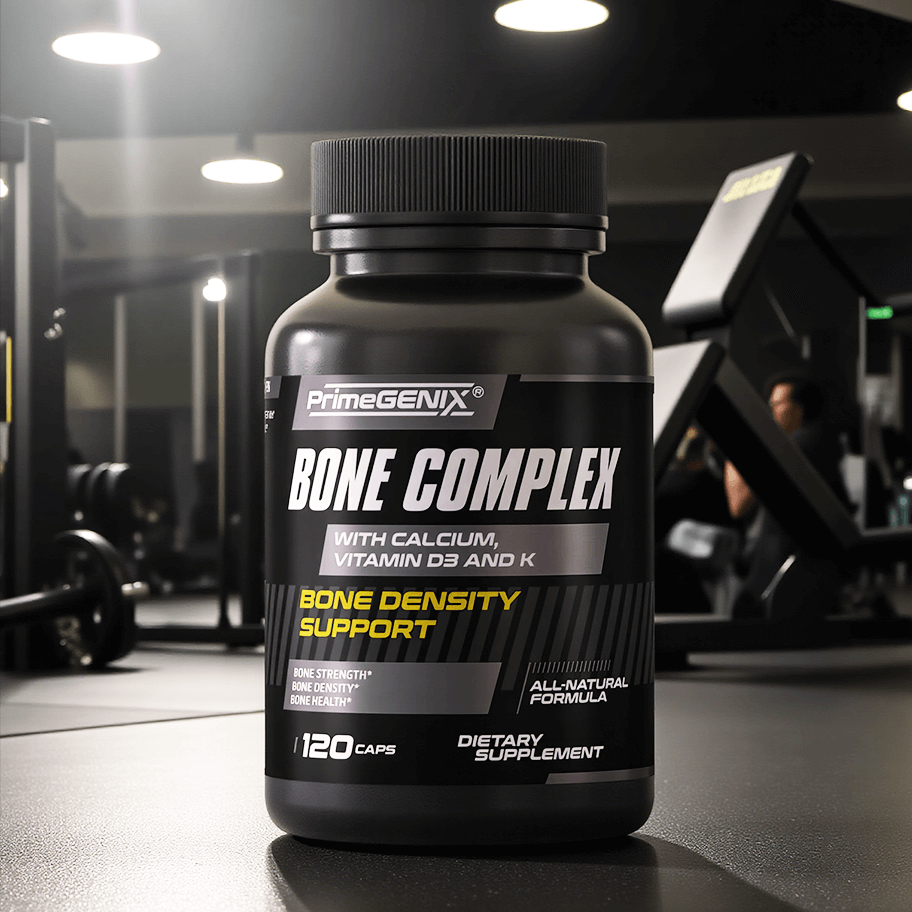
Affiliate disclosure: Our store sells PrimeGENIX Bone Complex through an affiliate link, and we may earn a commission if you buy it through our link, at no extra cost to you. Bone Complex is one of the combination products this question is usually asked about — its formula contains both vitamin D3 and vitamin K — so it is named where relevant below, from facts on its maker's own pages, which we audited for our review of the product. The question itself is a real one: a pharmacist answering it on Verywell Health opened with what readers keep asking — "We've seen online discussions about how vitamin K2 helps direct vitamin D to the right places in the body, and it's pointless to take vitamin D on its own. Is that true?" This article works through that claim the way we would want it worked through for us: mechanism first, evidence second, verdict last.
Quick Verdict: A Reasonable Pairing, Not a Requirement
No — you do not need vitamin K2 with your vitamin D. The pairing is optional, and the strongest version of the online claim — that taking vitamin D on its own is pointless, or worse, sends calcium to the wrong places — is not established by the evidence. The pharmacist's medically reviewed answer on Verywell Health lands in the same place: combining the two is a defensible choice, but it is unproven as a requirement. What follows is why the claim sounds so convincing, exactly where it outruns what is known, and the one situation in which vitamin K stops being an optional extra and becomes a medication question — anyone taking warfarin, which is important enough that we gave it its own article.
The Claim, Stated Fairly
The argument circulating online has three steps, and it deserves to be stated in its strongest form before it is checked. First: vitamin D increases how much calcium you absorb from food. Second: vitamin K2 activates proteins that handle that calcium — putting it into bone and keeping it out of soft tissue such as artery walls. Third: therefore, the claim goes, vitamin D without K2 is at best incomplete and at worst risky, because the extra absorbed calcium has no "directions" and ends up where it should not. The vivid shorthand is that D opens the door and K2 directs the traffic. It is a memorable story. The question is how much of it survives contact with what is actually demonstrated.
What Each Vitamin Actually Does
The first two steps rest on real biochemistry. Vitamin D's central job in this context is calcium absorption: it enables the gut to take up calcium from food and helps maintain the blood calcium level the body defends tightly. Vitamin K's role is as a cofactor in activating a family of proteins. Two of them carry the "direction" story: osteocalcin, produced in bone and involved in bone mineralisation, and matrix Gla protein, found in blood-vessel walls and cartilage, which in its activated form inhibits calcification of those tissues. Both proteins require vitamin K to be switched on. So the mechanism language is not invented: there genuinely are K-dependent proteins in bone and in vessel walls, and a genuine sense in which vitamin K participates in where calcium ends up. Any honest check of this claim has to concede that its foundation is real.
Where the Claim Outruns the Evidence
The failure is in the third step — the leap from "K-dependent proteins exist" to "vitamin D is pointless or hazardous without added K2." Three gaps separate the mechanism from the conclusion. First, no established finding shows that supplementing vitamin D at ordinary doses, without K2, causes calcium to be misdirected in healthy people; the frightening version is an extrapolation from the mechanism, not a measured outcome. Second, vitamin D's own evidence base contradicts "pointless": its effects on calcium absorption and deficiency were demonstrated in research that did not co-administer K2. A nutrient whose documented job is performed without the partner cannot be useless without it. Third, the combination itself has not been shown to be necessary — and the marketplace has not even settled what the combination is: K2 doses on labels range from token to substantial, the form alternates between MK-4 and MK-7, and no agreed target intake for the pairing exists. A requirement that nobody can state a dose for is not yet a requirement. That is why the pharmacist's framing — optional, unproven as a necessity — is the accurate one, and why the confident version sold on supplement pages should be read as marketing built on a mechanism, not as a finding.
The Label Problem Nobody Mentions
Suppose you decide to pair the two anyway, as many readers reasonably do. The labels make it surprisingly hard to do deliberately. On our own shelf, PrimeGENIX Bone Complex publishes its vitamin K amount in its maker's page text — 120 mcg per serving, specified in the maker's FAQ as the MK-4 and MK-7 forms — but its vitamin D3 amount appears only in the label image, not in the published text, and the maker never fixes how many capsules make a serving. A buyer cannot reconstruct the D-to-K pairing from the maker's own words. The contrast on the same shelf is instructive: GenF20 Algae Calcium prints its vitamin D3 amount in text — 20 mcg (800 IU) per serving — alongside its full component list. If the pairing matters to you, judge products by whether both numbers are published in plain text, not by the words "with K2" on the front of the bottle. A combination you cannot read is a combination you are taking on faith — which is what the claim's sellers are counting on.
Who Might Reasonably Add K2 Anyway
"Not required" is not the same as "pointless to add," and three reader profiles make the pairing a sensible preference rather than a rule. People taking higher-dose vitamin D over long periods sometimes prefer the combination as belt-and-braces, given the mechanism is real even if the requirement is unproven. People whose diets contain very little vitamin K — few leafy greens (the main K1 source) and few fermented foods or animal fats (the main K2 sources) — have a plainer nutritional gap to close. And people who simply adhere better to one combination product than to two separate ones get a consistency benefit that should not be dismissed. All three are judgement calls a reader can make with open eyes. None of them converts an optional pairing into the necessity the online claim advertises.
The Exception: When K Is a Medication Question
One group should never treat vitamin K as a casual add-on. Vitamin K interacts directly with warfarin, the older anticoagulant whose dosing is calibrated against a patient's vitamin K intake: adding a concentrated K supplement — K1 or K2 — can shift that balance, which is why pharmacists are asked "Can I take this if I'm on warfarin?" often enough for the question to recur across pharmacist Q&A columns. (Newer anticoagulants such as Eliquis work by a different mechanism and get a different answer; we work through the split in detail in our companion article on vitamin K2 and blood thinners.) For warfarin readers the rule is simple and non-negotiable: no vitamin K supplement, in either form, without your prescriber's knowledge. For everyone else, the pairing question can be decided on the evidence above — and the evidence says optional.
Frequently Asked Questions
Do we need to take vitamin D and K2 together?
No established requirement says so. The pairing is optional: the mechanism behind it (K-dependent proteins in bone and vessel walls) is real, but it has not been shown that vitamin D fails, or becomes harmful, without added K2. The medically reviewed pharmacist answer that prompted this article reaches the same conclusion.
Is it pointless to take vitamin D on its own?
No — that phrase is the claim, not a finding. Vitamin D's role in calcium absorption and deficiency was demonstrated without K2 co-supplementation. "Pointless alone" is marketing language built on a genuine mechanism, and it should be discounted accordingly.
Can you take vitamin D3, K2 and calcium together as supplements?
Yes — the trio is a standard combination, and combination bone formulas (Bone Complex on our shelf is one) are built on exactly it. The real cautions sit elsewhere: your total calcium intake from food plus supplements, and the warfarin question covered above — not in the combination itself.
Do I need supplements for these, or can I get enough from food?
For vitamin D, food sources are limited and sun exposure does most of the work in most lives, which is why supplementation is common. Vitamin K is easier from food: K1 from leafy greens, K2 from fermented foods and some animal products. A reader eating neither greens nor fermented foods is the one with a plausible dietary gap — and even then, the gap argues for adequacy, not for the "direction" claim.
These statements have not been evaluated by the Food and Drug Administration. This product is not intended to diagnose, treat, cure, or prevent any disease. This article is educational and is not medical advice.
Disclaimer: This article is for general information only and is not medical advice. Always consult a qualified healthcare professional before starting any supplement, especially if you have a medical condition or take prescription medication.
Last reviewed: October 2026
