
- Quick Answer: What the Evidence Actually Supports
- How Traction Is Supposed to Work
- The ProExtender Study: What It Measured, Exactly
- What the Wider Traction Literature Says
- The Gap Between the Study and the Instructions
- What Extenders Cannot Do, and the Risks the Sales Page Omits
- So, Do Extenders Work? Our Verdict
Affiliate disclosure: This article contains affiliate links. If you buy through a link on this page, we may earn a commission paid by the manufacturer, at no extra cost to you. That never changes what we publish — and on this page it cannot buy a softer verdict, because the most-cited study behind the best-known extender in our store is a small, preliminary 1998 report whose protocol almost no buyer actually follows. This article answers the question men type into search boxes and ask doctors directly — do penis extenders actually work? — using only what the studies and the makers' own documents say, including the parts the sales pages leave out.
Quick Answer: What the Evidence Actually Supports
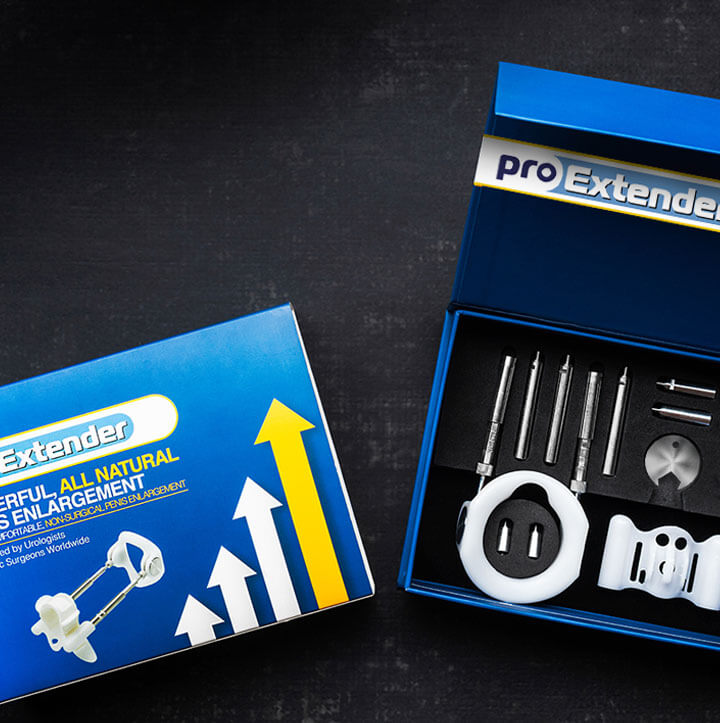
Extenders are the only enlargement method with any measured length outcomes at all — and the measurements are more modest, and more conditional, than the marketing. Penile traction is a real technique with a real literature behind it: urology journals have described extenders as a minimally invasive elongation option, and studies of traction devices as a class report average gains on the order of 1–3 cm over months of daily wear. The device-specific study behind ProExtender — the extender we sell — reported an average erect gain of 2.8 cm. But that study involved 18 men, was labelled "preliminary" by the maker itself, described no control group, and required 12 hours of wear a day — roughly double the 5–6 hours a day the maker's own usage guide tells buyers to wear it. Traction appears to do something real, slowly, at high daily wear times. Whether it does the same thing at the wear time real buyers manage is the question the evidence does not answer.
How Traction Is Supposed to Work
An extender holds the penis under gentle, sustained stretch for hours a day. The mechanism the makers describe is borrowed from orthopaedics, where controlled tension has been used for decades to lengthen tissue: sustained mechanical force prompts cells to divide, and over months the tissue adapts to the load. ProExtender's maker describes it the same way — the device applies a "stretch" (the "Traction Method") which "triggers a cell duplicating process (mitosis)," multiplying cells so the penis grows overall. That mechanism is plausible and is the reason traction, alone among enlargement methods, has attracted genuine clinical attention. Plausibility is not proof, though — which is why the studies matter more than the story.
The ProExtender Study: What It Measured, Exactly
The only study the maker presents as testing ProExtender itself is a report presented at the 1st International Interdisciplinary Symposium on Genitourinary Reconstructive Surgery in Barcelona in April 1998, by Dr Jorn Ege Siana of the Scandinavian Clinic of Plastic Surgery, Copenhagen. The maker's own results page publishes the design, which is more transparency than this category usually offers:
- 18 patients, ages 23–47, all with normal erectile capacity and no prior penile surgery.
- No control group is described — there was no comparison arm of men wearing a sham device or nothing at all.
- Protocol: 12 hours daily, 7 days a week, for 8 to 24 weeks, at traction forces rising from 900–1,000 g in the first two weeks to 1,000–1,200 g after that, with follow-up every two weeks.
- Result as published by the maker: an average increase in erect length of 2.8 cm (about 1.1 inches) after 1,100 hours at 1,200 g, and a flaccid increase of 1.9 cm. "No complications" were reported.
- The maker's own label for it: "Preliminary study." It was a symposium presentation; the maker cites no peer-reviewed journal, volume or pages for it.
Read fairly, that is a real signal inside a weak design. Eighteen men is a very small sample. Without a control group, there is no way to separate the device's effect from measurement variation, expectation, or the simple fact that stretched tissue measures longer. And the result was produced at a wear time — 12 hours a day, every day — that the maker's current usage guide does not ask of buyers. The homepage re-presents this same study as a "100% success rate" with "+29% length and +19% girth"; the results page's own conclusions state length only, and the girth figure does not appear in them. When a maker's homepage and its own results page tell the same study two different ways, believe the results page.
What the Wider Traction Literature Says
Beyond that one device, traction as a class has been studied more seriously — and the maker quotes some of it. Two pull-quotes on ProExtender's homepage come from the literature about extenders generally, not about this brand: the British Journal of Urology (July 2008) — "penile extenders should be regarded as a minimally invasive and effective treatment option to elongate the penile shaft" — and a 2010 National Library of Medicine line calling extenders "the only evidence-based technique of penile elongation." Both statements are about the technique. Neither tested ProExtender.
The most-cited class study is the Turin work by urologist Paolo Gontero and colleagues: men using an extender for six months gained on average about 0.9 inches flaccid and up to half an inch erect, per the summary on ProExtender's own site — which also concedes, against its own interest, that "the extender used did not live up to its claim." Note two things: the device in that study was not ProExtender, and the gains were smaller than the headline percentages on any extender's sales page. That pattern — real but modest average gains, at high daily wear, over about six months — is the honest centre of the whole traction literature. How many hours a day that actually takes is the subject of our wear-time guide.
The Gap Between the Study and the Instructions
This is the single most important fact in this article, and it comes entirely from the maker's own documents. The 1998 study's protocol was 12 hours a day. The maker's Usage Guide tells buyers that after a start-up phase "most men wear it for 5–6 hours daily," and that a full course runs 4–6 months. There is no published study of ProExtender at 5–6 hours a day. A buyer following the instructions is running a protocol at roughly half the tested dose of the only device-specific evidence that exists — and total hours is the variable every traction researcher agrees drives the result. The guide itself says that after start-up, "the results depend only on the total amount of hours worn and the traction involved." By the maker's own logic, halving the hours should be expected to change the outcome; by how much, nobody has measured.
What Extenders Cannot Do, and the Risks the Sales Page Omits
Three honest limits. First, speed: nothing in the literature supports the homepage's "measurable results in just 2 weeks" framing as a length outcome — the maker's own results timetable puts noticeable, measurable lengthening at weeks 4–12. Second, girth: the device study's conclusions report length only; girth claims rest on homepage copy, not on the study. Third, certainty: the maker's sales pages claim "100% safety without injury," a "completely painless" process and enlargement "without risk of side effects." Its own Usage Guide anticipates soreness and irritation behind the glans, warns "don't go to extremes," and the maker's own site article notes extender use requires care "to prevent injury or permanent damage." The guide's version is the one to plan around. No contraindications are published anywhere in the maker's material — nothing on injury, skin conditions, implants, bleeding disorders or diabetes — and that absence is a gap in the paperwork, not evidence that no caution is needed.
These statements have not been evaluated by the Food and Drug Administration. This product is not intended to diagnose, treat, cure, or prevent any disease. This article is educational and is not medical advice.
So, Do Extenders Work? Our Verdict
On the evidence that can be checked: traction is the one enlargement method that has produced measured length gains in human studies — typically on the order of 1–3 cm over roughly six months, at wear times of many hours a day. That is a real answer, and it is also a much smaller, slower, more conditional answer than any sales page gives. For ProExtender specifically, the evidence is one small, preliminary, uncontrolled 1998 study run at double the wear time the maker now recommends — which is why our ProExtender review scores its evidence 6.0/10 rather than the certainty the homepage sells. If you buy an extender, buy it as a six-month, hours-a-day commitment whose likely outcome is a modest average gain — and read ProExtender, Answered for the price, guarantee conditions and safety gaps before you do. Anyone whose concern is curvature should read our traction and Peyronie's guide first — that is a medical conversation before it is a purchase.
Disclaimer: This article is for general information only and is not medical advice. Always consult a qualified healthcare professional before using a traction device, especially if you have a medical condition, a penile injury, or take prescription medication. Individual results vary, and no result is guaranteed.
Last reviewed: October 2026
