
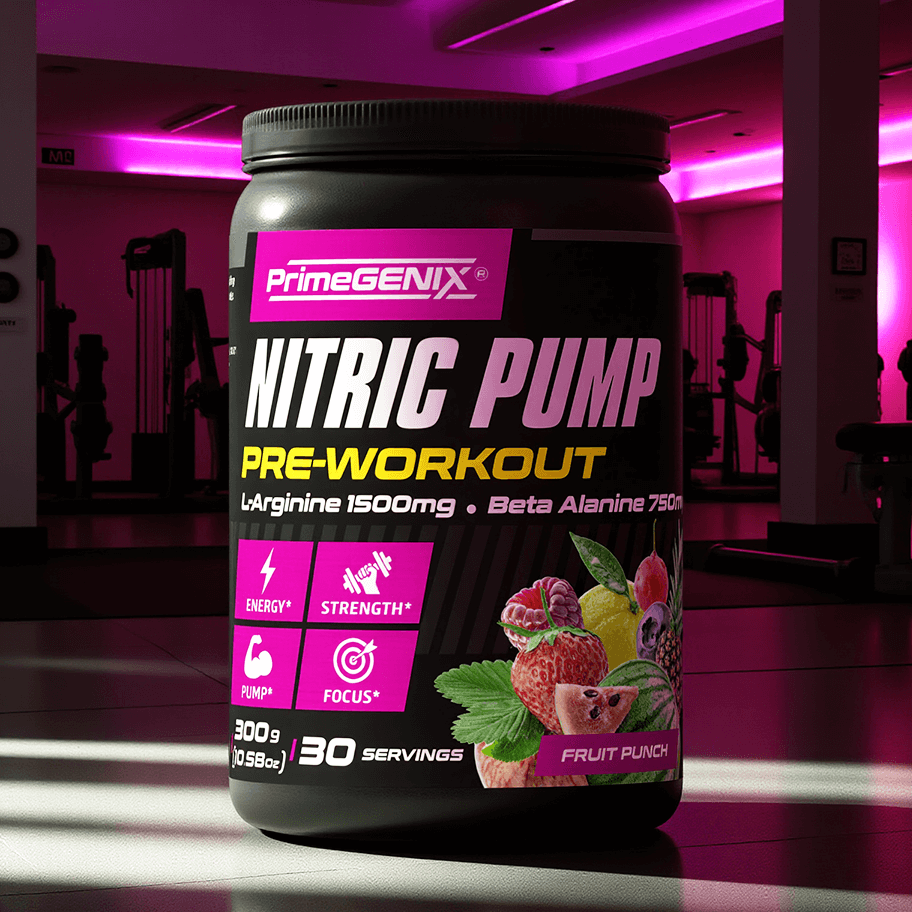
Affiliate disclosure: We sell PrimeGENIX Pre-Workout — sold by its maker under the name Nitric Pump (PrimeGENIX; our score 4.0/10) — through our affiliate link and earn a commission if you buy it. It is the worked example in this article for an instructive reason: it is marketed on pump and "clean energy," yet its own label lists caffeine among its ingredients at a dose the maker nowhere publishes. Everything printed about it below comes from the maker's page, including the parts — no amounts, no cited studies, leftover template text — that keep its score where it is.
Quick Answer
A pre-workout does two different jobs, and only one of them is caffeine's. The pump, endurance and strength-support side of the formula is built from amino acids and related compounds — citrulline, arginine, beta-alanine, creatine compounds — whose role in the category has never depended on stimulation. The energy and focus side is where caffeine works, and removing it removes the wired, alert feeling and most of the crash risk with it. So a non-stimulant pre-workout is a coherent idea: keep the pump stack, drop the stimulant. Whether any given product works is a separate question that only two things can answer — published doses and cited evidence — and that is where the category, and our shelf's example in particular, collapses: PrimeGENIX's Nitric Pump publishes no ingredient amounts at all (everything sits inside a named "matrix") and cites no study for the product or any ingredient. A pump stack can be real. This one's cannot be checked.
Two Jobs in One Scoop
Read any pre-workout label as two formulas sharing a tub. The first is the performance stack. On the Nitric Pump page its members are named plainly: L-citrulline malate and L-arginine alpha-ketoglutarate (the blood-flow, "pump" pair the product takes its name from), beta-alanine, dicreatine malate, betaine anhydrous, L-taurine, plus waxy maize carbohydrate, B-vitamins and electrolytes — the only quantity stated anywhere in the copy is 373 mg of electrolytes. The maker's claims for the whole are supports for energy release, strength gains, bigger pumps, greater endurance and increased focus. None of those named performance ingredients is a stimulant; the pump side of a formula is, by design, the part that does not need caffeine to be itself.
The second formula is the stimulant side, and on this label it is a single word: caffeine — listed among the ingredients, with L-tyrosine and glucuronolactone for company in the "Energy/Endurance/Focus Matrix." Caffeine's contribution to a workout is the feeling of energy and sharpened focus, and its costs are the familiar ones: jitters for the sensitive, a crash afterwards, and ruined sleep when training runs late. The maker's pitch — "clean energy without the crash" — is aimed precisely at buyers tired of those costs. Which is what makes the label worth reading to the end: a product marketed against the stimulant experience still contains the stimulant, at a dose printed nowhere.
What Removing Caffeine Actually Removes
For a genuinely stimulant-free product, the trade is clear and, for many lifters, attractive. You give up the acute energy-and-focus lift — the part of a pre-workout you can feel within minutes — and the alertness that helps some people train harder than they otherwise would. You keep the pump stack, whose ingredients are aimed at blood flow, muscular endurance and output rather than sensation. You also keep your sleep: evening trainers are the natural audience for stim-free formulas, because a 6 p.m. workout followed by a full caffeine dose is a reliable way to be staring at the ceiling at 1 a.m. And you keep a stable baseline if you already drink coffee — no double-counting a stimulant you cannot see.
What you do not give up is any proven pump effect, because the pump was never caffeine's job. What you cannot keep — and this is the part the category's marketing skips — is verifiability. A stim-free claim tells you one ingredient is absent. It tells you nothing about whether the ingredients present are dosed at levels anyone has studied, and in blend-based formulas you cannot find out.
These statements have not been evaluated by the Food and Drug Administration. This product is not intended to diagnose, treat, cure, or prevent any disease. This article is educational and is not medical advice.
The Blend Problem: A Matrix Is Not a Dose
Nitric Pump's actives sit inside a named blend — the "Energy/Endurance/Focus Matrrix" (the maker's spelling) — and the maker publishes no per-ingredient amounts anywhere in its text; the Supplement Facts exist only as product images. That single fact disables every judgement a buyer might make. Is there enough citrulline malate to matter, or a dusting? How much caffeine is in a scoop — a cup of coffee's worth, or three? The page does not say, and the dose directions cannot rescue it: one scoop in 8–10 oz of water, 20–30 minutes before training, beginners to start with half a scoop, 30 servings per tub — with the scoop's weight in grams also unpublished. A half-scoop of an unknown quantity of an unknown caffeine dose is not a dosing strategy; it is a shrug printed as instructions. The same fog is why this product cannot even certify itself stimulant-free or stimulant-light: the caffeine is present, and its amount is the maker's secret.
The Rest of the File
The evidence section of the maker's page is, in full, generic language: the formula is "scientifically designed with powerful, clinically studied ingredients" and "backed by science" — with no specific study cited for the finished product or for any ingredient. Around that emptiness sit the page-quality findings from our audit: three body sections repeatedly describe the formula as "Nitric Shock™," a different product's name pasted into this page's copy; four feature blocks still contain the shop platform's placeholder text ("Pair text with an image to focus on a product…"); and several ingredient names are misspelled in the maker's own list. The commercial terms, at least, are plain: $39 a tub at the single-tub tier (multi-tub tiers at $69 and $99), no subscription offer on the page, and the maker's store-wide 67-day money-back guarantee. None of that repairs the central problem, which is that the product asks to be judged on a formula it will not quantify.
Frequently Asked Questions
Can a pre-workout work without caffeine?
The pump and endurance side of the formula never depended on caffeine — citrulline, arginine, beta-alanine and creatine compounds are the non-stimulant core of the category. What you lose without caffeine is the felt energy and focus lift. Whether a specific product's pump stack is dosed to do anything is a label question, and on blend-based labels like Nitric Pump's it cannot be answered.
Is PrimeGENIX Pre-Workout (Nitric Pump) stimulant-free?
No — and its own label says so, if you read the ingredient list: caffeine is in the formula. What the maker claims is "clean energy without the crash," and it publishes no caffeine amount, so a buyer cannot tell whether a scoop carries a little caffeine or a lot. If stimulant-free is your requirement, this product does not meet it on its own paperwork.
Why don't makers publish the amounts?
The stated reason is usually formula protection; the practical effect is that no serving can be compared with any study. On this page the amounts are absent even from the text of the Supplement Facts, the scoop weight is unpublished, and the only quantity in the entire copy is 373 mg of electrolytes. Judge that as the finding it is.
Is there any study behind Nitric Pump?
None is cited. The maker's page offers general "backed by science" language and names no study of the product or of any ingredient. Every performance claim on the page — pumps, strength, endurance, focus — therefore rests on the category's reputation rather than on evidence attached to this formula.
Who is a non-stimulant pre-workout actually for?
Evening trainers protecting their sleep, caffeine-sensitive lifters, and people already getting caffeine from coffee who want the pump stack without stacking stimulants. For those buyers the category makes sense — provided the label prints its doses, which is the condition our shelf's example fails.
The Verdict
"Non-stimulant" is a meaningful label and a coherent design: the pump side of a pre-workout was never the stimulant's job, and dropping caffeine costs you the buzz, not the blood-flow ingredients. But the label only earns its keep on a product whose doses you can read. PrimeGENIX Pre-Workout (our score: 4.0/10) fails that test in both directions at once — it contains caffeine it does not quantify, inside a matrix that quantifies nothing, behind claims supported by no cited study. If you shop this category, shop the arithmetic: named ingredients, printed amounts, a caffeine line that says a number — or, for a true stim-free product, says zero. A maker unwilling to print any of those is asking you to feel the difference and call it evidence.
Disclaimer: This article is for general information only and is not medical advice. Always consult a qualified healthcare professional before starting any supplement, especially if you have a medical condition or take prescription medication.
Last reviewed: October 2026
