
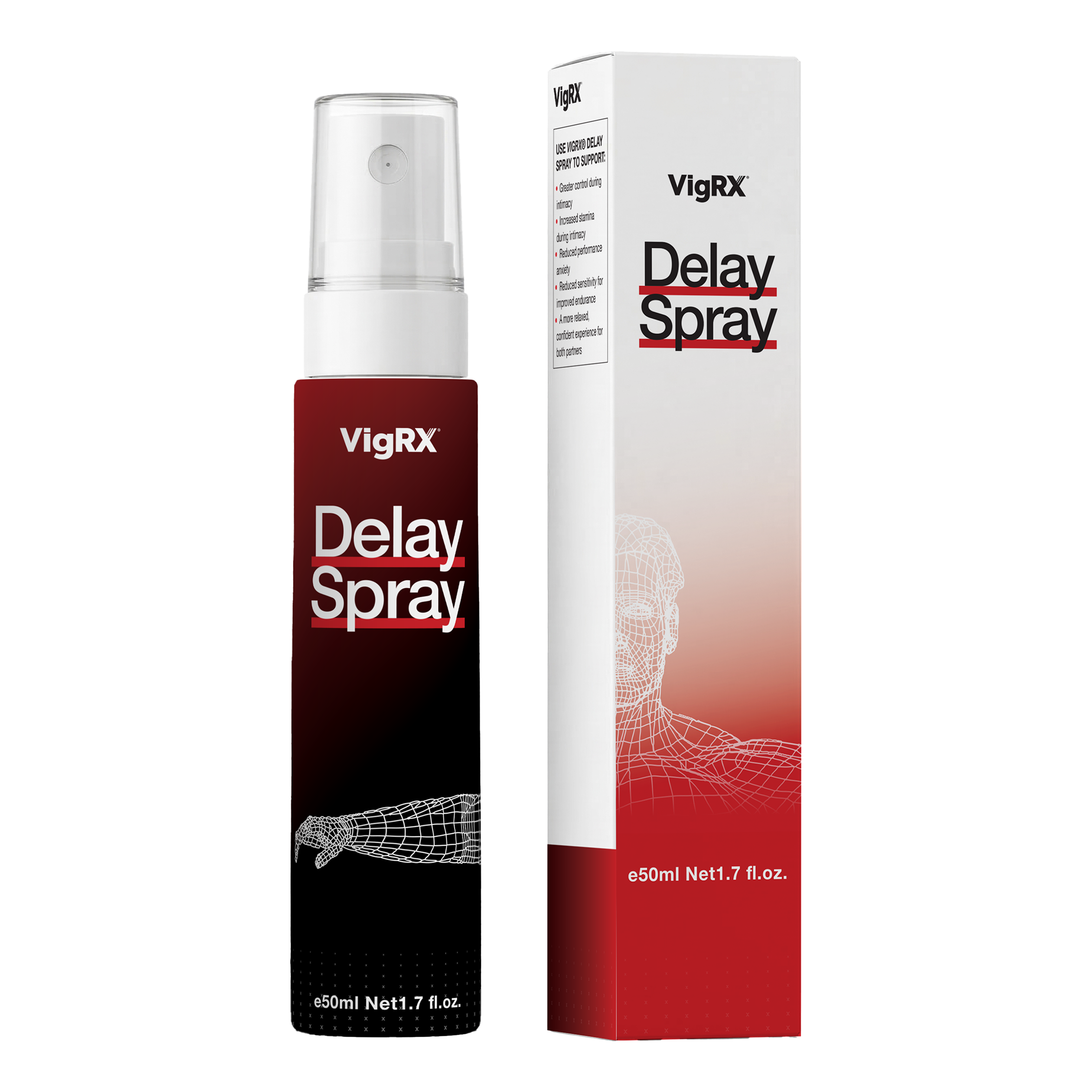
Affiliate disclosure: We sell both products audited here — VigRX Delay Spray (Our Score 4.5/10) and VigRX Delay Wipes (Our Score 5.5/10) — through affiliate links and earn a commission if you buy either. The two products sit under the same brand, from the same maker, and their labels give two different answers to the condom question. This article reports labels, including the conflicts between them and across the category, rather than smoothing them into one reassuring rule — because on this question, the label in your hand is the only authority that matters.
Quick Answer: There Is No Category Rule
"Can I use delay spray with condoms?" is one of the delay category's standard questions, reproduced across retailer and clinic FAQ sets — and the honest answer is that the labels genuinely conflict. One major brand's spray label states flatly that it is not compatible with condoms. Health-service guidance cited in the category's literature points the other way and treats condoms as actively recommended alongside local-anaesthetic products. Between those poles, the two labels we sell from land in two different places: the spray's maker states it is water-based and latex-condom compatible, while the wipes' maker makes no compatibility claim at all, advising only that the formula absorb fully before a condom is applied and deferring to the condom manufacturer's guidelines. Four positions, one question. Anyone who gives you a single yes or no for "delay sprays" as a class is flattening paperwork that does not agree with itself.
Why the Labels Disagree
The conflict is not arbitrary; it follows from what these products are. A delay spray is an active ingredient carried in a base, and the base — water-based in our spray's case, something else in another maker's — is what meets the condom. Compatibility is therefore a property of a specific product paired with a specific condom material, not of the delay category. That is why one maker's label can prohibit what another's permits, and why health guidance can recommend condoms in general while a particular label forbids them in particular: the guidance is about the practice, the label is about the pairing. It is also why the wipes' hedge is, structurally, the most defensible sentence of the four — "consult the condom manufacturer's guidelines" is an admission that compatibility has two authors. The practical translation: a condom claim is only ever as good as the two labels it was read from, the product's and the condom's, and this article now reads the two we sell from.
Label One: The Spray Claims Compatibility
For VigRX Delay Spray, the maker's position is stated without hedging: the formula is water-based, and the maker claims it is compatible with latex condoms. Two boundaries belong around that claim, both visible in the maker's own material. First, the claim names latex. The maker publishes nothing about non-latex condom materials — not a claim, not a caution — so a reader using polyisoprene or polyurethane condoms holds a question this label does not answer; the condom maker's guidelines are the only paperwork that speaks to it. Second, the compatibility claim sits inside a directions set that still has to be followed: the spray is applied 1–3 times to the shaft and glans and rubbed in, about 10 minutes before intimacy, and the maker's transfer FAQ conditions its "minimal transference" statement on the spray being applied correctly and allowed to absorb. A condom applied over wet, unabsorbed spray is outside the conditions of every claim on the page — the compatibility claim included, in spirit if not in letter. And the label's other condom-adjacent instruction survives any pairing: wash thoroughly before oral sex, printed in the warnings, condom or no condom.
Label Two: The Wipes Hedge
The VigRX Delay Wipes label answers the same question in a different grammatical mood. It claims nothing. Its complete condom guidance is: "Allow the wipe formula to absorb fully before applying a condom. If you have concerns about material compatibility, consult the condom manufacturer's guidelines." Read beside the spray's flat claim, the hedge can look like a weakness; read as paperwork, it is a different and arguably more honest instrument. The wipes' formula is two botanicals — Zanthoxylum Oil and Peony Extract, no benzocaine, no synthetic anaesthetic — carried on a wipe rather than in a sprayed base, and the maker has evidently chosen not to assert a pairing it would have to stand behind across condom brands. What the hedge does give the user is a sequence that is safe under every reading: apply, absorb fully, then condom. What it withholds is the one-word answer. A buyer who wants a printed compatibility claim from the maker will not find one here and should not let any review site — including ones that describe these wipes, wrongly, as a benzocaine product with the spray's paperwork — supply it on the maker's behalf.
These statements have not been evaluated by the Food and Drug Administration. This product is not intended to diagnose, treat, cure, or prevent any disease. This article is educational and is not medical advice.
The Wider Shelf: A "No" Label and a "Yes" Guidance
The two VigRX positions make more sense with the category's extremes on the table. At one pole, a major brand's delay spray label states the product is not compatible with condoms — a complete prohibition, printed by the maker of that spray, presumably because its base and latex do not get along. At the other pole, health-service guidance quoted across the category recommends condoms with local-anaesthetic products — as a practice, both for protection and because a barrier limits exactly the transfer that makes partners numb. Neither pole cancels the other; they are answers about different pairings and different purposes. The mistake the category's content usually makes is picking one pole and presenting it as the rule. A man holding the "no" brand who reads a generic "sprays are fine with condoms" page has been actively mis-served, and a man holding our spray who reads a generic "never combine them" page has been scared off a pairing its own maker claims. The label-by-label method is slower than a slogan. It is also the only method that survives contact with an actual bathroom cabinet containing an actual product.
The Sequence That Respects Every Label
Strip the four positions down to the actions none of them contradict, and a conservative sequence emerges — stated as our synthesis, not as any maker's directions. Apply the product as its own label directs (for the spray: 1–3 sprays, rubbed in, about 10 minutes ahead; for the wipes: one wipe, applied directly). Wait for full absorption — the spray's transfer claim is conditioned on it, and the wipes' only condom instruction consists of it. Then apply the condom, having checked the pairing the way the labels ask: the spray's maker claims latex compatibility; for anything else — non-latex materials, the wipes generally — the condom manufacturer's guidelines govern. Wash before oral sex regardless, per the spray label's printed warning. And if the product in your hand is one whose label prohibits condoms, the sequence does not rescue it: that prohibition is the answer for that product, full stop. Transfer mechanics beyond the condom question — waiting, wiping excess, what a partner actually feels — are worked through in Does Delay Spray Numb Your Partner?, and correct application generally in our how-to guide.
Frequently Asked Questions
Can I use delay spray with condoms?
It depends on the spray — which is the whole finding of this page. The spray we sell carries a maker claim of latex-condom compatibility; another major brand's spray label prohibits condoms outright; health guidance recommends the combination in general. There is no category answer, only the label of the product you own, read next to the guidelines of the condom you own.
Is VigRX Delay Spray compatible with condoms?
Its maker says so, with a scope: the formula is water-based and the claim names latex condoms. The maker publishes nothing about non-latex materials, and the claim presumes correct use — applied as directed and allowed to absorb. Our audit records the claim as the maker's; the full product file is on its product page.
Can I use the delay wipes with a condom?
The wipes' maker makes no compatibility claim either way. Its guidance is procedural: let the formula absorb fully before applying a condom, and consult the condom manufacturer's guidelines if you have concerns about material compatibility. Any site stating a flat yes or no for the wipes is going beyond the maker's paperwork.
Should the condom go on before or after applying the spray?
After — under every label we audited. The product is applied to the skin and given its directed time to absorb (about 10 minutes for our spray; "absorb fully" for the wipes); the condom follows. Applying spray over a condom appears in no maker's directions and would defeat the absorption every claim depends on.
Does a condom stop the spray numbing my partner?
A condom is a barrier, and health guidance recommends it partly for that reason — but the maker's own transfer position does not rest on the condom; it rests on correct application and full absorption, which it describes as making transference minimal. Treat the condom as protection and a second line of defence, not as a substitute for the wait. The full transfer picture is in our partner piece.
The Bottom Line
On condoms, this category's labels say four different things — a claim, a hedge, a prohibition and a recommendation — and all four are in print at once. The two products on our shelf split the difference between them: the spray claims latex compatibility as a water-based formula; the wipes claim nothing and prescribe absorption plus the condom maker's guidelines. Neither answer transfers to any other product, and no other product's answer transfers to them. Read the two labels you actually own; on this question, that is not caution, it is the entire method.
Disclaimer: This article is for general information only and is not medical advice. Follow the directions and warnings on your own product's label and your condom manufacturer's guidelines first; if you have a medical condition or a known sensitivity to local anaesthetics, consult a doctor or pharmacist before using a delay product.
Last reviewed: October 2026
