
Affiliate disclosure: This article contains affiliate links. If you buy through a link on this page, we may earn a commission paid by the manufacturer, at no extra cost to you. That never changes what we publish — and here it means giving you the unglamorous version of this answer, because the glamorous version ("yes, rebuild it all") is the one that sells jars, and it is not the one the evidence supports.
Can you rebuild collagen you've already lost? It is the question underneath almost every purchase in this category — the cream, the powder, the serum are all bought in the hope that what age and sun have taken can be put back. The honest answer has two halves, and they are not equally marketable. You can support the collagen production you still have, and you can slow further loss — both genuinely. What the evidence does not show is any cream or supplement rebuilding your skin's collagen back to a younger baseline. This page explains where that line sits, and then ranks the levers that actually exist by how much they can do.
Quick Answer: Can You Rebuild Lost Collagen?
Not to a younger baseline — no. Neither a collagen cream nor an oral collagen supplement rebuilds deep collagen; the cream's collagen cannot even reach the layer where yours lives, and the supplement's evidence supports, at most, modest improvements in skin hydration and elasticity. What you can do is real, just narrower: protect the collagen you still have (sun protection does more of this than any product), support your body's own ongoing production (retinoids have the strongest topical evidence; peptide products and oral peptides have weaker, partial evidence), and stop the habits that accelerate the loss. Think of it as defending a position and nudging output upward — not rewinding the structure to where it was at 25.
What Does "Lost Collagen" Actually Mean?
Two different processes get bundled into the word "lost," and separating them matters because they respond to different things. The first is slowing production: collagen production declines gradually from early adulthood, so each year your skin lays down a little less new collagen than the year before. The deficit builds slowly, over years — which is also why anything that nudges production upward spends its first gains on slowing the loss rather than reversing it.
The second is active breakdown, and its biggest external driver is not age at all. Ultraviolet exposure is the single biggest external driver of collagen breakdown: sunlight doesn't just fail to help, it dismantles existing collagen, and it does so faster than any cream or powder can support new collagen. Smoking is consistently linked to faster collagen loss and poorer skin repair as well. In other words, part of your "lost" collagen wasn't only a production problem — it was removed faster than it was replaced, by things that are partly under your control.
Why Can't a Cream or Powder Simply Put It Back?
Because of routes and sizes. A collagen molecule in its natural form weighs roughly 300,000 Daltons, and dermatology's long-standing rule of thumb — the 500 Dalton rule — is that compounds larger than about 500 Daltons generally cannot pass through the skin's outer barrier. Even hydrolyzed collagen fragments, at roughly 1,000 to 5,000 Daltons, stay above that line. The collagen in a jar therefore works on the surface only: it hydrates, forms a light film, and makes fine lines look temporarily softer. We walk through the full mechanism in our guide to whether collagen cream actually works.
An oral supplement avoids the skin barrier — it is digested, broken into amino acids and very small peptides, some of which are absorbed intact and have been detected in skin tissue. That route is biologically plausible, and trials have reported modest improvements in measured skin hydration and elasticity after about 8 to 12 weeks of daily use. But modest support for hydration and elasticity is not rebuilding: when researchers stress-tested the oral research, the outcomes for wrinkle reduction and dermal density — the structural changes "rebuilding" would require — did not hold up. We lay both formats side by side in Collagen Cream vs Collagen Supplements: Which Does What?
These statements have not been evaluated by the Food and Drug Administration. This product is not intended to diagnose, treat, cure, or prevent any disease. This article is educational and is not medical advice.
What Actually Helps, Ranked by What It Can Do?
Since rebuilding is off the table, the realistic goals are defence first, then support. In order of how much each lever can plausibly do:
- 1. Sun protection — the biggest lever, and it isn't a collagen product. Ultraviolet light actively breaks down the collagen you still have, faster than any product can support new production. Daily sunscreen protects more collagen than any cream can pretend to add. Everything below this line accomplishes less if this line is missing: an unprotected face in daily sun can undo a product's entire contribution.
- 2. Retinoids — the strongest topical evidence for stimulating production. Retinoids are small enough (around 300 Daltons) to cross the skin barrier, and they carry the strongest topical evidence for stimulating collagen production. If you use one product class for that purpose, it is that one — ideally with a dermatologist's guidance, and with the adjustment period (dryness, flaking, sun sensitivity) taken seriously.
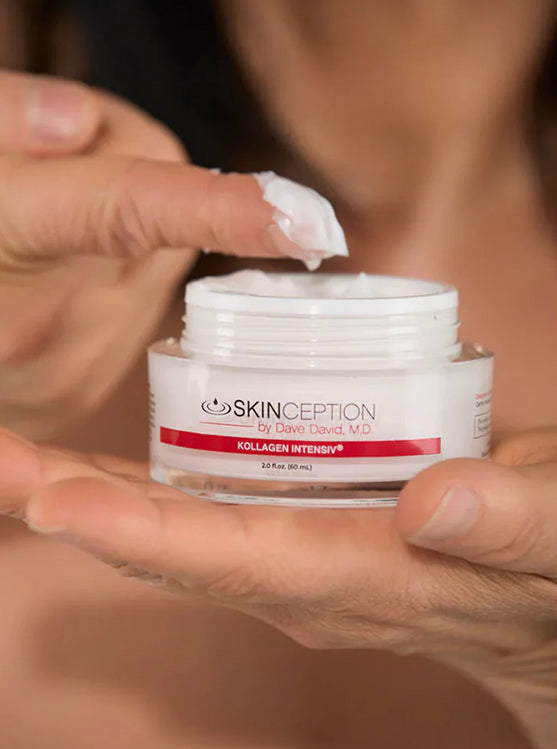
- 3. Peptide creams — real but narrower topical support. Better collagen creams are built around signal peptides designed to support the collagen your skin makes itself, rather than collagen itself. The best-known example on this site: the peptide trial behind Kollagen Intensiv's key ingredient, SYN-COLL, ran 84 days of twice-daily use, and the maker reports a 354% improvement in the appearance of wrinkles and a 201% improvement in skin texture versus placebo. Those are maker-reported figures from a trial of the ingredient, not of the finished jar — promising, provisional, and measured at day 84, not day 14.
- 4. Oral collagen peptides — modest, systemic support. Trials report modest improvements in hydration and elasticity after 8 to 12 weeks, with real weaknesses in the research: the studies disagree with each other, follow-up is short, and industry involvement is frequent — in the highest-quality, non-industry-funded studies, the apparent benefits were markedly weaker or not significant. Take it as plausible support, not structural repair.
- 5. The free foundations — protein, vitamin C, sleep, no smoking. Collagen is built from amino acids, so adequate protein is raw material; vitamin C intake supports normal collagen synthesis; the body does much of its repair work in sleep; and smoking is linked to faster loss. None of these is dramatic, all of them are free, and a routine built on products while ignoring them is building on sand.
How Long Does Supporting Production Take to Show Anything?
On the skin's schedule, not the marketer's. Your surface cells turn over on a cycle of roughly 28 days in a young adult, slowing toward 40 days or more by your fifties, and collagen remodeling in the dermis is slower still — construction work measured in months. That is why the peptide trial ran 84 days and the oral studies measure at 8 to 12 weeks, and why the first visible gains from any support routine tend to look like "less decline, better hydration, slightly smoother texture" rather than transformation. Judge by photographs taken in the same light at day 1, 30, 60, and 90 — memory is a generous reviewer, and photographs are stricter.
What Should You Stop Believing?
Three claims should retire. "This cream puts collagen back into your skin" — the molecule cannot get there; physics, not brand quality. "This powder rebuilds your collagen" — the evidence supports modest hydration and elasticity support; the structural outcomes did not hold up under stress-testing. And "results in days" — what changes in days is surface hydration, which is real and pleasant and temporary, and is moisturizer doing moisturizer's job under a collagen label.
The bottom line: you cannot rebuild lost collagen to a younger baseline with anything sold in a jar or a tub — and a page that sells collagen products is exactly where that should be said plainly. What you can do is worth doing: protect what remains with sunscreen, stimulate production with the one topical class that has the evidence, add peptide or oral support with modest expectations and a 12-week judging window, and keep the free foundations in place. That programme defends and nudges. It does not rewind — and anyone who prices it as a rewind is charging you for the difference.
Disclaimer: This article is for general information only and is not medical advice. Always consult a qualified healthcare professional before starting any supplement, especially if you have a medical condition or take prescription medication. Individual results vary, and no result is guaranteed.
Last reviewed: October 2026
