
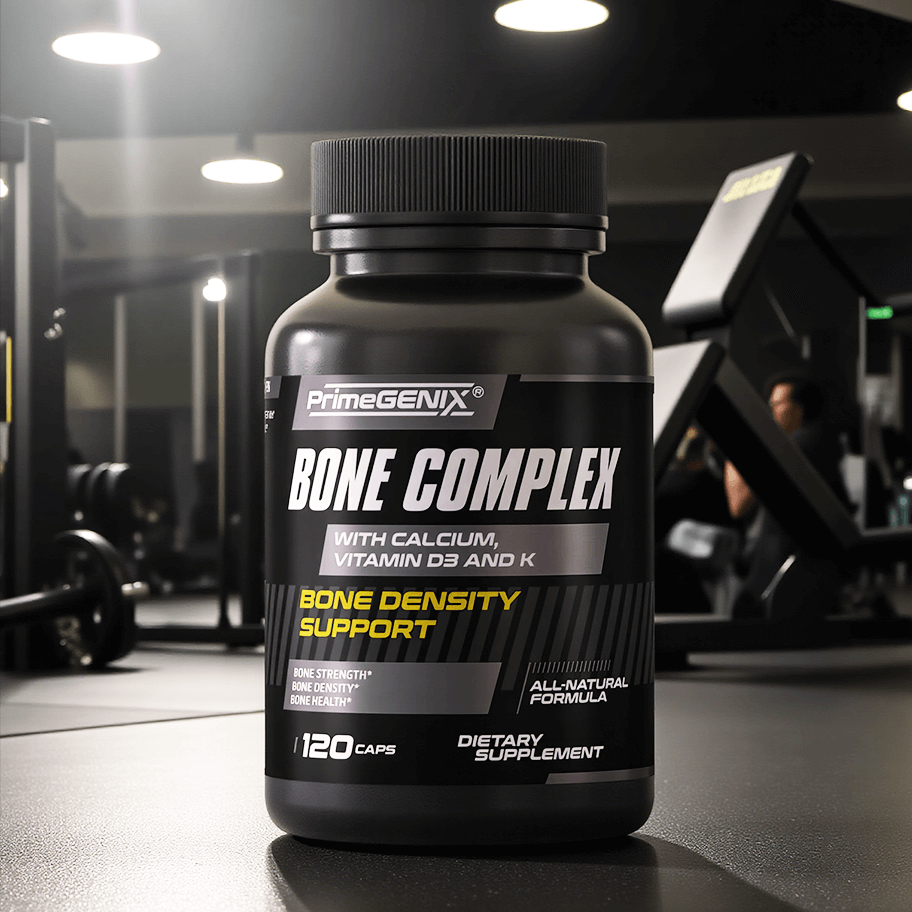
Affiliate disclosure: This article contains affiliate links. If you buy through a link on this page, we may earn a commission paid by the manufacturer, at no extra cost to you. The bone supplement on our shelf is PrimeGENIX Bone Complex (Our Score 5.5/10), a ten-nutrient formula marketed specifically to men — and this page is written to survive that commercial interest: it explains what bone density measurement actually is, what any supplement can and cannot do about it, and exactly where this product's paperwork is strong, thin, or silent. Nothing here is a substitute for a DEXA scan or a clinician's reading of one.
Quick Answer: Measurement First, Supplements Second
Bone density in men declines with age just as it does in women — more slowly, and usually noticed later, often only after a fracture. The measurement that settles the question is a DEXA scan, reported as a T-score: −1.0 or above is normal, between −1.0 and −2.5 is low bone mass (osteopenia), and −2.5 or below is osteoporosis. A supplement can supply the raw materials bone is built from — calcium, vitamin D, vitamin K, magnesium and the trace minerals around them. What it cannot do is measure your density, prove it raised anyone's, or stand in for treatment when a T-score says treatment is needed. No trial of the finished Bone Complex product is cited by its maker at all, so every claim for it is a claim about its ingredients, not about the capsule.
Why This Is a Men's Conversation Too
The supplement aisle treats bone health as a women's category, and PrimeGENIX's entire pitch is built on that gap: an all-natural bone formula "designed specifically for men," aimed at active men who want to protect training, work and mobility as density declines. The underlying point is legitimate. Men lose bone mass with age, male fractures carry serious consequences, and because screening is less routine for men, the loss is typically discovered later. A man in his 40s or 50s who has never thought about bone density is not unusual — he is the norm this category ignores. What follows separates the three questions that marketing usually blurs into one: how density is measured, what nutrients can plausibly contribute, and what this specific product's file actually shows.
What a DEXA Scan Measures: T-Scores, Plainly
DEXA (dual-energy X-ray absorptiometry) is a low-dose scan, usually of the hip and spine, that measures bone mineral density and compares it against two references. The T-score compares you with a healthy young adult: −1.0 or higher is the normal range; between −1.0 and −2.5 is low bone mass, called osteopenia — a warning zone, not a disease in itself; −2.5 or lower meets the threshold for osteoporosis. (A second figure, the Z-score, compares you with others your age; clinicians use both, plus your fracture history and risk factors, rather than any single number.) Three practical consequences follow. First, you cannot feel your T-score: density loss is silent, which is why the scan, not symptoms, is the starting point. Second, a result in the osteoporosis range is a medical conversation — about prescription treatment, fall risk, vitamin D status and causes — before it is a supplement conversation. Third, any supplement claim that skips the scan entirely is asking you to buy an input for a number you do not know.
What a Supplement Can Do — and What It Can't
The honest version of the supplement case is a supply argument. Bone is living tissue under constant remodelling, and remodelling consumes calcium, vitamin D (which governs calcium absorption), vitamin K (involved in the proteins that bind calcium into bone), magnesium, phosphorus and trace elements including zinc, copper, manganese and boron. Where a diet runs short on those, a supplement can close a nutritional gap — that is a real, modest, unglamorous function, and it is the ceiling of what the format offers. What no supplement on this shelf has shown: that taking it raises a man's T-score, reverses diagnosed osteoporosis, or prevents fractures. Those are outcome claims, and outcomes require trials of the finished product in people. Bone Complex's maker cites no study of the finished product — its evidence is short journal quotations about individual nutrients. Ingredient plausibility is not product evidence, and the distance between them is exactly where bone-supplement marketing lives.
The Bone Complex File, on Its Paperwork
The formula names ten nutrients: vitamins C, D3 and K, calcium, phosphorus, magnesium, zinc, copper, manganese and boron. On amounts, the maker's text publishes only three: calcium 900 mg per serving, vitamin C 100 mg and vitamin K 120 mcg. The other seven amounts appear only inside a label image, not in text a buyer can check. One question we deliberately leave open: published secondary sources disagree about the chemical form of that calcium, and the maker's materials do not give a buyer a text label from which to settle it — so this page prints the amount, which is published, and no form, which we cannot verify from the maker. The directions are similarly loose: "one serving per day," with the number of capsules in a serving nowhere fixed in the maker's text (its retail store suggests anywhere from 1 to 6 capsules "depending on your needs"), and the capsule count per bottle unpublished. The page also carries a plain copy error — the section headed "Vitamin D3" contains the vitamin C text, and the "Vitamin C" section contains the vitamin K text — and states the target age two different ways in different sections. None of this makes the formula wrong. It makes the daily cost and content harder to pin down than they should be for a $59 bottle: packs run $159 for three and $299 for six, a subscription is $49 a month, and the guarantee is 67 days.
These statements have not been evaluated by the Food and Drug Administration. This product is not intended to diagnose, treat, cure, or prevent any disease. This article is educational and is not medical advice.
The Missing Warfarin Caution
One silence in this file deserves its own section. The formula contains vitamin K at 120 mcg per serving — a meaningful amount of a vitamin whose best-known interaction is with warfarin and other blood thinners, where vitamin K intake directly affects how the medication works. Yet across the maker's pages there is no warfarin or blood-thinner caution of any kind — no warnings or exclusions section at all, only the assurance that the compounds are natural and have "no known negative side effects." A maker's claim of no side effects is not a safety analysis, and for this ingredient it is not a small omission: men over 40 are precisely the readership most likely to be prescribed an anticoagulant. We cover the underlying interaction in Vitamin K2 and Blood Thinners and the vitamin D pairing question in Do You Need Vitamin K2 With Your Vitamin D? If you take warfarin or any anticoagulant, this product is a clinician conversation first — the label will not start it for you.
Frequently Asked Questions
At what age should a man get a DEXA scan?
There is no single birthday rule we can print responsibly: clinicians order DEXA based on risk — age, prior fractures, family history, low body weight, smoking, alcohol, certain medications and conditions. If you are over 40 and have never discussed bone density with your doctor, the scan is the first step, before any product on this page.
Can a supplement raise my T-score?
No supplement on our shelf has published a trial showing its finished product raised anyone's T-score. Bone Complex's maker cites no product trial at all — its evidence is ingredient-level journal quotations. Adequate calcium and vitamin D intake supports bone health; that is a supply claim, not a measured density outcome.
How much calcium is in Bone Complex?
The maker's text publishes 900 mg of calcium per serving, alongside vitamin C 100 mg and vitamin K 120 mcg. The remaining seven ingredients' amounts appear only in a label image, and the maker does not fix how many capsules make up a serving — so the per-capsule figures cannot be stated from its text.
Is Bone Complex safe with warfarin?
The maker publishes no warning either way — and that silence is the problem, because the formula contains 120 mcg of vitamin K, which interacts with warfarin. Do not rely on the maker's "no known negative side effects" claim; ask your prescribing clinician before using it.
How is this different from GenF20 Algae Calcium?
They are different makers' answers to the same shelf: Bone Complex is a ten-nutrient men's formula from PrimeGENIX; GenF20 Algae Calcium is Leading Edge Health's plant-sourced calcium product, audited separately on its own product page. Compare published amounts and guarantees, not category language.
The Practical Verdict
For men after 40, the order of operations is: get measured (a DEXA scan and a T-score you can point to), fix the nutritional basics, and treat any supplement as gap-filling supply — never as the intervention itself. PrimeGENIX Bone Complex (Our Score 5.5/10) assembles the right nutrient roster and publishes three of its ten amounts, then leaves the rest in a label image, leaves its serving size unfixed, and publishes no warfarin caution beside a 120 mcg vitamin K dose. Buy it, if you buy it, as a documented-imperfect nutrient supply inside a measured plan — and if your T-score is already in the osteoporosis range, the purchase that matters is a clinician, not a capsule.
Disclaimer: This article is for general information only and is not medical advice. Always consult a qualified healthcare professional before starting any supplement, especially if you have a medical condition or take prescription medication.
Last reviewed: October 2026
