
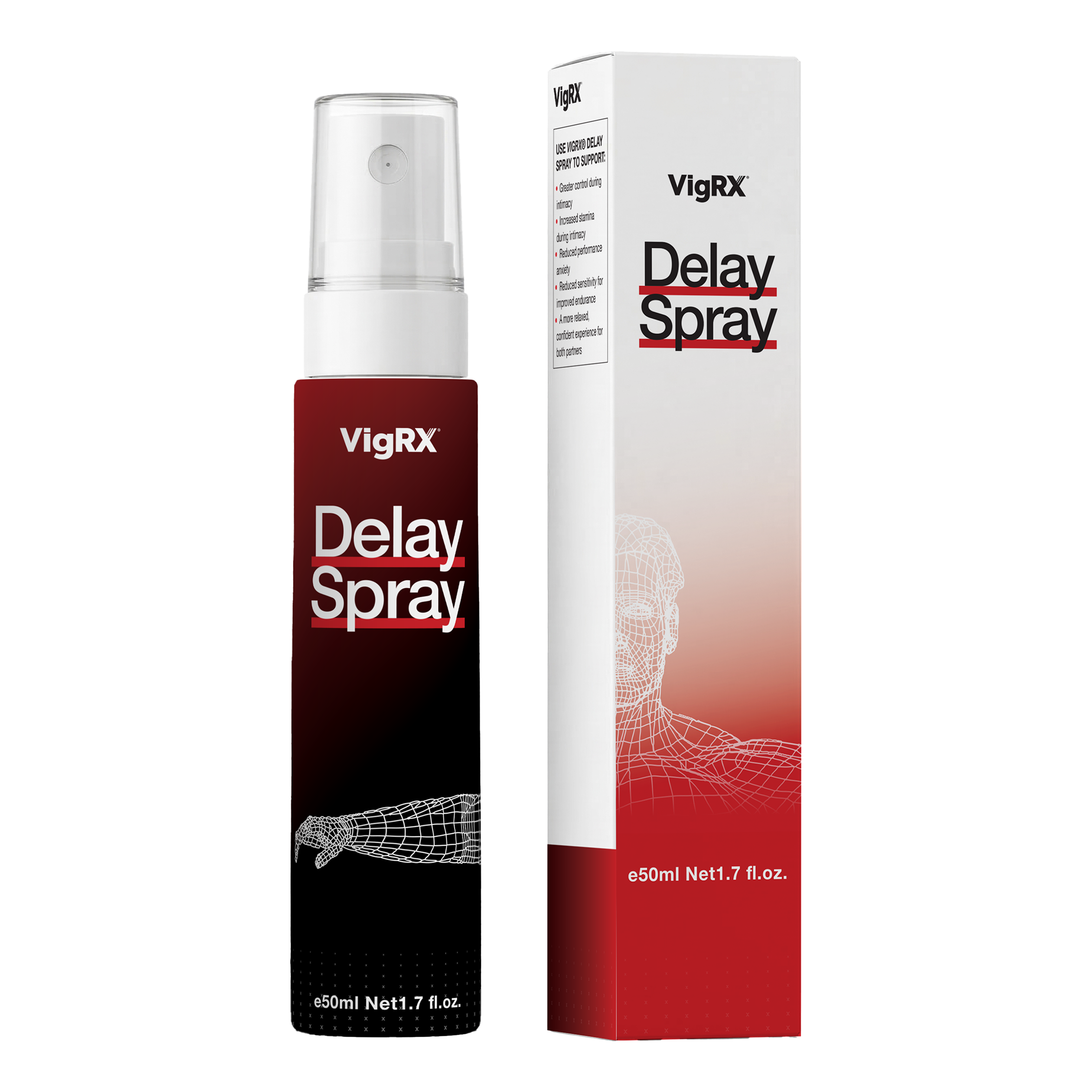
Affiliate disclosure: We sell VigRX Delay Spray (Our Score 4.5/10) through our affiliate link and earn a commission if you buy it. This article exists because its duration is the category's most-asked timing question — "How long does delay spray last?" appears, word for word, in the FAQ sets of Innerbody, Promescent and retailer sites — and because the honest answer for the product we sell has a hole in it: its maker publishes an onset direction and no duration figure at all. Where this page gives a number, it says whose number it is.
Quick Answer
Two different clocks run on a delay spray, and they come from two different sources. Onset: the maker of the spray we sell directs application about 10 minutes before intimacy — that is the wait it prints, and the only timing figure in its material stated as a direction. Duration: the working window the category's FAQ answers most commonly describe is roughly 30–60 minutes — but that figure belongs to the category's collective paperwork, not to this product. VigRX's maker publishes no duration claim for its spray: not in the directions, not in the FAQ, not in the guarantee terms. So the accurate answer is a split one — onset, about 10 minutes by the label; duration, a 30–60-minute category window that this specific maker has never committed to print. Any page that gives you an exact duration for this spray is giving you a number its maker declined to.
Onset: The Ten Minutes Are the Label's
Onset is the one part of the timeline this maker does specify, and it specifies it as an instruction rather than a measurement: spray 1–3 applications onto the shaft and glans, rub in thoroughly, about 10 minutes before intimacy, starting with one spray and adjusting. Two honest qualifications ride on that figure. First, it is a directed wait, not a tested onset — the maker cites no study of the finished spray, so "10 minutes" is the label's choreography, not a stopwatch result from a trial. Second, the wait is load-bearing in both directions. Apply and proceed immediately and the benzocaine has not taken effect yet, which is the most common route to the conclusion that a spray "doesn't work" — followed, too often, by a second application that arrives all at once. Our how-to guide is built around the real over-application cases that pattern produces. Wait the full directed time and the same wait also does the transfer-control work: the maker's own FAQ states transference to a partner is minimal when the spray is applied correctly and allowed its 10 minutes to absorb — the condition is part of the claim.
Duration: Where the 30–60 Minutes Actually Comes From
The 30–60-minute window is real, but it is a category figure, and this article will not launder it into a product specification. It is the range the delay category's FAQ literature — Innerbody's guides, Promescent's FAQ, retailer question sets — converges on when answering the identical question this page is titled with. Those answers describe benzocaine and lidocaine sprays as a class, at their various published strengths, used as directed. They do not describe this bottle, for a reason that should by now be familiar to readers of this cluster: the maker of the spray we sell publishes neither a duration nor the benzocaine percentage that would let anyone reason from the class data to this product. The two gaps compound. A class window assumes a known strength; an unpublished strength makes the window an analogy, not an estimate.
What can be said about duration from the maker's own material is structural rather than numerical. The product is an on-demand, as-needed application with no daily regimen — there is no build-up and no carry-over to the next occasion. The effect belongs to the application: it ends as the product wears off or is washed off, and the maker's own directions concede the washing point by instructing users to wash thoroughly before oral sex. The maker's headline performance language — "Last Twice as Long" — is a claim about the encounter, not a duration specification for the spray, and it arrives with no study behind it: no trial of the finished spray is cited on any maker page we audited. Treat the 30–60 minutes, then, as the category's planning figure — reasonable for deciding when to apply — and treat its absence from this product's label as what it is: the maker leaving the most-asked question about its product to other people's paperwork.
These statements have not been evaluated by the Food and Drug Administration. This product is not intended to diagnose, treat, cure, or prevent any disease. This article is educational and is not medical advice.
Reapplication: The Question the Label Doesn't Answer
Can you spray again if the first application fades — or if it wasn't enough? Here the label's silence is total, and this page prints the silence rather than filling it: the maker publishes no reapplication guidance. No interval, no same-evening second dose, no statement of whether a second application resets the 10-minute wait. What the directions do state is a ceiling — 1–3 sprays per application, do not exceed the recommended application — and a ceiling is not a reapplication protocol. A user who sprays three, waits, finds it insufficient and sprays three more has, by the only arithmetic the label provides, exceeded the recommended application; a user who sprays one and tops up with one more an hour later is in territory the maker simply never describes.
The reason this gap deserves a section rather than a shrug is that the failure mode on the far side of it is documented. The over-numbing cases in our safety audit — a man who test-applied a spray and reported "my penis got numb that much," and the patient whose doctor told him full touch sensation could take up to three months to return after heavy overexposure — are dose-stacking stories. Nobody in them set out to overdose; they re-applied, or applied generously once, inside a paperwork vacuum. The defensible practice, stated as ours and not the maker's: treat one application as the occasion's whole dose, calibrate upward across occasions rather than within one, and if an application genuinely fades mid-evening, let the evening be the data point for next time's count instead of re-spraying blind. It is less satisfying than a protocol. It is also the only advice consistent with the label that actually exists.
The Wipes, for Contrast: No Onset, No Duration
If the spray's timeline is half-published, the VigRX Delay Wipes (Our Score 5.5/10) timeline is not published at all. The maker's complete timing instruction for the wipes is to apply one wipe and allow the formula to absorb and dry fully before sexual activity — no minute count for onset, none for duration, only the word "fast-acting" in the positioning. We state this plainly because the temptation in category writing is to lend the wipes the spray's 10 minutes and the class's 30–60, and both loans would be fabrications: the wipes contain no benzocaine and no synthetic anaesthetic — the full formula is Zanthoxylum Oil and Peony Extract — so even the analogy that props up the spray's window does not reach them. Their timeline, on the maker's paperwork, is: apply, dry, proceed, unknown. Our dedicated guide, How to Use Delay Wipes, works through what that means in practice.
Frequently Asked Questions
How long does delay spray last?
The category's FAQ answers converge on roughly 30–60 minutes of working effect for anaesthetic sprays used as directed. For the specific spray we sell, the maker publishes no duration figure at all — so 30–60 minutes is a class-level planning figure, not this product's specification, and any exact number attached to this bottle elsewhere is not the maker's.
How long does it take to start working?
For the spray we sell, the maker directs application about 10 minutes before intimacy and rubbing in thoroughly — treat that full wait as the onset. Spraying and proceeding immediately is the most common reason men conclude a spray doesn't work, and the usual prelude to over-applying.
Can I reapply delay spray if it wears off?
The maker of our spray publishes no reapplication guidance — no interval and no second-dose instruction. Its only stated rule is the ceiling: 1–3 sprays per application, do not exceed the recommended application. Stacking extra sprays inside one occasion is the pattern behind the documented over-numbing cases, so we advise treating one application as the whole dose and calibrating on the next occasion instead.
Does washing or showering end the effect?
Washing removes the product, and with it the effect — the maker's own directions rely on this, instructing users to wash thoroughly before oral sex. A shower mid-window ends the occasion's application; the maker publishes nothing about re-applying after washing, which is the same reapplication gap described above.
How long do the delay wipes last?
Unknown from the maker's paperwork: it publishes no onset time and no duration for the wipes, only "fast-acting" positioning and an instruction to let the formula absorb and dry fully. Their botanical, benzocaine-free formula also means the anaesthetic class window cannot simply be borrowed for them.
The Short Version
Onset has a label figure — about 10 minutes for the spray we sell. Duration has only a category figure — the 30–60-minute window the FAQ literature describes for the class — because this maker publishes none of its own, alongside the unpublished benzocaine percentage that would make the class figure properly applicable. Reapplication has no figure and no protocol at all, only a ceiling that doubles as the category's main safety rule. Buy the spray, if you buy it, on that paperwork: precise about how to start, silent about how long it lasts and whether you may go again — our full audit is on the VigRX Delay Spray product page, and the format alternatives are compared in Delay Spray vs Delay Wipes vs Delay Cream.
Disclaimer: This article is for general information only and is not medical advice. Follow the directions and warnings on your own product's label first; if you have a medical condition or a known sensitivity to local anaesthetics, consult a doctor or pharmacist before using a delay product.
Last reviewed: October 2026
