
- Quick Answer: How Long Does Collagen Take to Work?
- Why Are There Two Different Collagen Timelines?
- What Can a Collagen Cream Do in the First 2 Weeks?
- How Long Do Collagen Powders and Peptides Take?
- What Should You Expect at Week 4, Week 8, and Week 12?
- Why Is Collagen So Slow to Show Results?
- What Speeds Up — or Slows Down — Visible Results?
- How Should You Judge Whether It Is Working?
- When Should You Stop?
Affiliate disclosure: This article contains affiliate links. If you buy through a link on this page, we may earn a commission paid by the manufacturer, at no extra cost to you. That never changes what we publish — and here it means giving you the slower, less flattering timeline rather than the "visible results in days" version, because the slower one is the true one.
How long does collagen take to work? The honest answer depends entirely on which kind you mean, because a collagen cream and a collagen powder run on two different clocks. One works on the surface of your skin, the other works through digestion and your body's own collagen production. Confusing the two timelines is how most people end up disappointed with both. This page separates them.
Quick Answer: How Long Does Collagen Take to Work?
Creams: hydration and smoother feel can arrive within days, but that is cosmetic and temporary. Any real change in texture or firmness is judged over 8 to 12 weeks — the best-known trial of a leading collagen-support peptide ran a full 84 days. Powders and peptides: most skin studies measure results at 8 to 12 weeks, and joint studies often run longer. At 2 weeks: expect moisturized, more comfortable skin — not structural change. No honest product of either type can promise visible rebuilding in a fortnight.
One more number worth knowing before you start either clock: skin cell turnover takes roughly 28 days in a young adult and slows noticeably with age, stretching toward 40 days or more by your fifties. Any product that works by supporting new skin simply cannot outrun that cycle.
Why Are There Two Different Collagen Timelines?
A cream and a powder are not two strengths of the same thing — they are different products doing different jobs. A so-called collagen cream usually does not deliver collagen into the skin at all. Collagen molecules are too large to pass through the skin's surface, which is why better creams are built around peptides and other ingredients designed to support the collagen your skin makes itself. We explain the full mechanism in our guide to whether collagen cream actually works. What a cream can do immediately is hydrate the surface — and hydrated skin looks smoother and plumper within hours. That early glow is real, but it is moisturizer doing moisturizer's job.
An oral collagen powder works the other way around. The peptides are digested, absorbed as small amino-acid chains, and — according to the research behind them — used as building material and signals for your own collagen production. Nothing about that pathway is fast: absorption, distribution, synthesis, and then the slow remodeling of existing tissue. Expect the powder's clock to be measured in months because the biology is measured in months.
What Can a Collagen Cream Do in the First 2 Weeks?
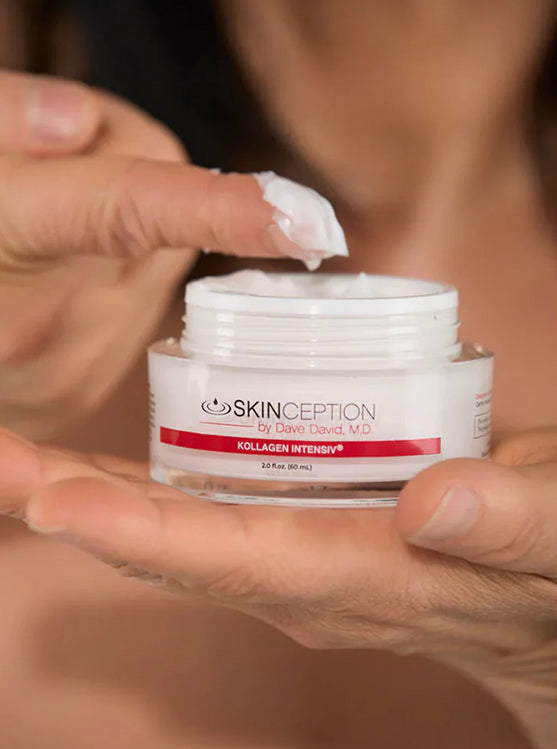
Realistically: hydration. A good cream base — humectants and emollients such as glycerin and shea butter — reduces water loss from the surface, and skin that holds water looks smoother, feels softer, and shows fine lines less prominently. Many users report that "something is working" within the first week or two, and something is: the moisturizer. What has not happened in two weeks is new collagen. The peptide trial behind Kollagen Intensiv's key ingredient, SYN-COLL, ran for 84 days of twice-daily use before its wrinkle and texture outcomes were recorded. The maker reports the women in that study saw a 354% improvement in the appearance of wrinkles and a 201% improvement in skin texture versus placebo — maker-reported figures from a trial of the ingredient, not of the finished jar, and both measured at day 84, not day 14.
So treat the first two weeks of any cream as the hydration phase and nothing more. If a seller promises firmer, rebuilt skin inside a fortnight, they are selling you the moisturizer effect under a collagen label.
These statements have not been evaluated by the Food and Drug Administration. This product is not intended to diagnose, treat, cure, or prevent any disease. This article is educational and is not medical advice.
How Long Do Collagen Powders and Peptides Take?
The published studies on oral collagen peptides for skin mostly run 8 to 12 weeks before measuring changes in elasticity and hydration, and the better ones show modest, gradual improvements rather than dramatic ones. Studies on joint comfort frequently run 12 to 24 weeks, sometimes longer, because cartilage-related outcomes change even more slowly than skin. If you are drinking a powder, the fair checkpoint is three months of daily use — and even then, the honest expectation is "somewhat better hydration and elasticity," not a younger face in the mirror.
Powders also carry a practical timeline problem creams do not: consistency. A cream sits on your counter; a powder has to be mixed, drunk, and tolerated every day for a quarter of a year. Most people who report "collagen did nothing" stopped at week three — before the first study checkpoint would even have been measured.
We compare the two formats directly here: Collagen Cream vs Collagen Supplements: Which Does What?
What Should You Expect at Week 4, Week 8, and Week 12?
Timelines are easier to hold to when they are broken into checkpoints. For a cream used twice daily: by week 4, one full surface-turnover cycle, expect reliable hydration and possibly a slightly smoother feel — the moisturizer phase, plus the earliest window in which peptide support could begin to register. By week 8, two cycles in, texture changes become a fair thing to look for in your photos. By week 12, you are at the trial's own endpoint — the point where the SYN-COLL numbers were recorded — and whatever the cream is going to do should be visible in a side-by-side comparison.
For a powder taken daily, shift everything a little later: week 4 is still the silent phase for most people, week 8 is the first honest checkpoint for skin hydration and elasticity, and week 12 is where the studies that found effects actually measured them. Judging either product at week 2 or 3 and quitting is the single most common way people waste money in this category — they pay for a 12-week experiment and abandon it before the first measurement point.
Why Is Collagen So Slow to Show Results?
Three reasons, none of them fixable by a stronger product:
- Skin turnover is slow. The surface cells you see today were formed weeks ago. Even with perfect support, a visibly renewed surface has to grow out, and turnover slows with age — roughly 28 days when young, longer each decade after.
- Collagen remodeling is slower still. Collagen sits in the dermis, beneath the surface. Laying down and reorganizing it is construction work, not decoration, and the body does it on a schedule of months.
- You are fighting a deficit that built up over years. Collagen production declines gradually from early adulthood. A cream or powder is nudging production upward against a long-term downward trend — the first gains go to slowing the loss, not reversing it.
What Speeds Up — or Slows Down — Visible Results?
Sun exposure is the big one. Ultraviolet light actively breaks down collagen, and it does so faster than any cream or powder can support new collagen. An unprotected face in daily sun can undo a product's entire contribution; sunscreen is worth more than any jar on this page. The same applies to smoking, which is consistently linked to faster collagen loss and poorer skin repair.
Consistency beats intensity. The peptide study used the cream twice a day, every day, for 84 days. Applying double amounts twice a week is not the same trial and should not be judged as one. Sleep, adequate protein, and vitamin C intake all support normal collagen synthesis too — none of them dramatic, all of them free.
How Should You Judge Whether It Is Working?
Memory is a terrible measuring instrument for changes this gradual. Judge like a study would:
- Take a photo on day 1, then at days 30, 60, and 90 — same room, same lighting, same angle, no filter. Compare the photos, not your recollection.
- Change one thing at a time. If you start a cream, a powder, and a new serum in the same week, you will never know which one earned the result — or the irritation.
- Score the specific claims. Texture and firmness at 8–12 weeks for a cream; hydration and elasticity at 8–12 weeks for a powder; joint comfort later still. "I feel like I look better" at week 2 measures moisturizer and optimism.
When Should You Stop?
If you have used a cream exactly as directed for a full 12 weeks and your same-lighting photos show no change you can point to, stopping is reasonable — you have run the trial the ingredient research describes, and longer use is hope, not evidence. The same logic applies to a powder at three months: no measurable difference, no obligation to continue.
With Kollagen Intensiv, one deadline needs flagging plainly: its money-back guarantee is 67 days, while the SYN-COLL trial behind it ran 84 days. The guarantee does not cover a full trial-length test — it forces your decision around day 60, on the hydration and early texture evidence you have by then, rather than at day 84. That is still a workable checkpoint: a complete absence of any change by day 60 is meaningful information. But go in knowing the refund clock runs out before the research clock does, and put a calendar note at day 55 rather than discovering it at day 70.
The bottom line: collagen — cream or powder — is a 8-to-12-week question, and anyone who tells you otherwise is selling moisturizer effects or wishful thinking. Set the checkpoints before you start, take the photos, protect the work with sunscreen, and let the timeline the studies actually used be the timeline you judge by.
Disclaimer: This article is for general information only and is not medical advice. Always consult a qualified healthcare professional before starting any supplement, especially if you have a medical condition or take prescription medication. Individual results vary, and no result is guaranteed.
Last reviewed: October 2026
