
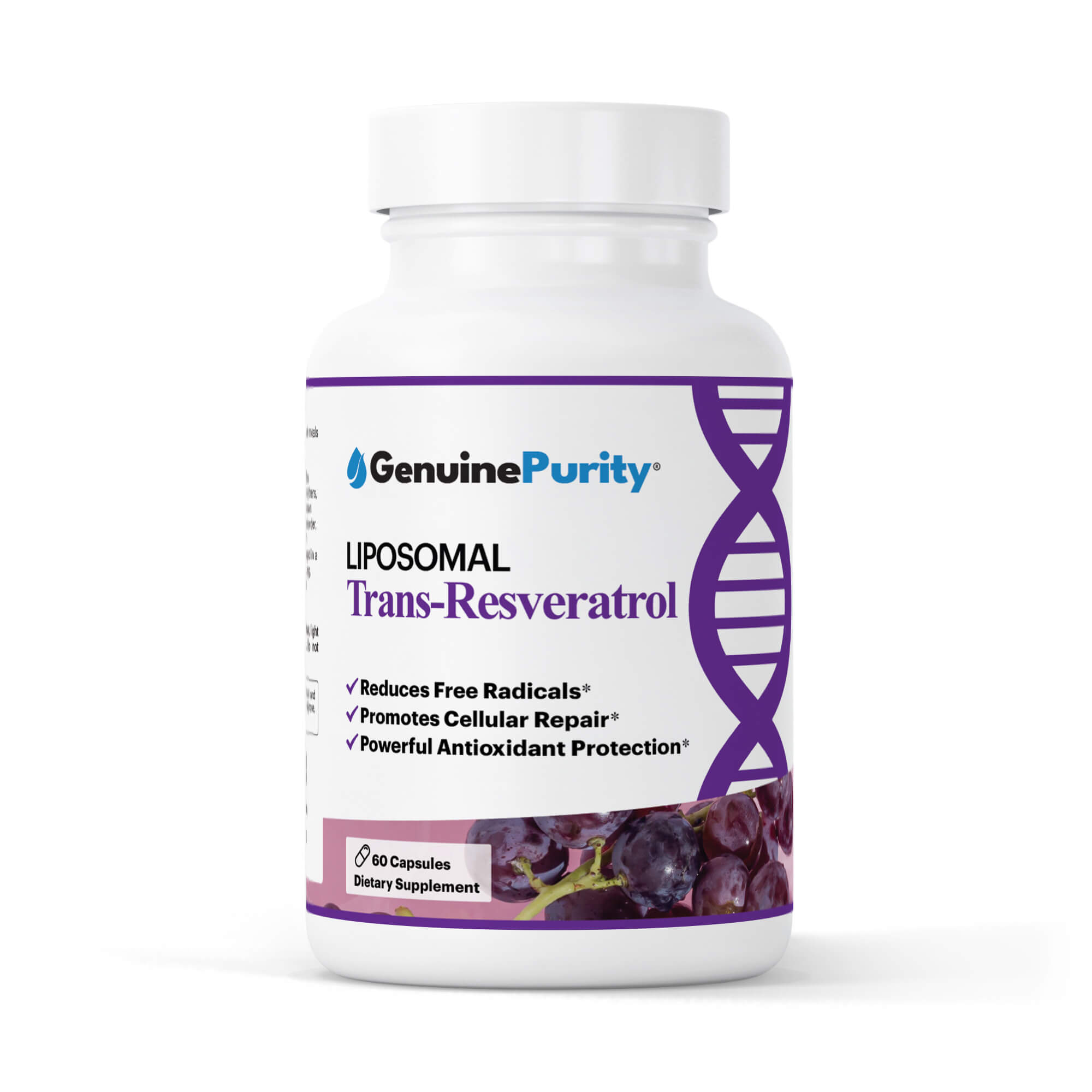
Affiliate disclosure: This article contains affiliate links. If you buy through a link on this page, we may earn a commission paid by the manufacturer, at no extra cost to you. That never changes what we publish — and here it means answering the GenuinePurity Resveratrol questions in the words buyers actually search them, including the awkward one its own maker's website raises: whether the bottle is 98% or 99% pure. GenuinePurity Resveratrol earns an Our Score of 7.5/10 in our review. This page shows what that score is made of.
Quick Answer: What Is GenuinePurity Resveratrol?
What it is: a liposomal trans-resveratrol supplement from GenuinePurity, a Leading Edge Health brand, positioned for healthy aging under the heading "Cellular, Immune and Senolytic Support." Its single active is trans-resveratrol from Japanese knotweed root, at 500 mg per daily serving — two capsules — with the full capsule contents published and no proprietary blend. Does it work? No trial of the finished product is described anywhere on the maker's pages; its evidence is ingredient-level, presented as journal quotations about resveratrol and blood-sugar control. Price and guarantee: $59 for one bottle, with a 97-day money-back guarantee — the longest judging window in our catalog. And its one self-inflicted problem: the maker's store page states 99% purity while its landing page headlines 98%. Both figures are the maker's. Neither has been reconciled.
What Is Actually in It?
One active ingredient, fully listed. Trans-Resveratrol (from Polygonum cuspidatum / Japanese knotweed root extract) — 500 mg per daily serving. The rest of the capsule is published in full: Vegetable Cellulose (Capsule), Microcrystalline Cellulose, a Phospholipid Complex (Sunflower Lecithin, Phosphatidylcholine) — the liposomal delivery component, present in the open rather than hidden behind a blend name — Silicon Dioxide and Vegetable Stearate. The bottle holds 60 capsules, which at the directed two a day is a 30-day supply. The maker states that its products are tested and certified by third-party laboratories, with Certificates of Analysis published on the site, and itself advises buyers to see a COA before purchasing any supplement. There is no proprietary blend, and there is no published list price — the store page shows no struck-through MSRP.
So Is It 98% Pure or 99% Pure?
The maker publishes both, on different pages, and we are not going to pick one for it. The current store page describes "99% Pure Trans-Resveratrol - 500mg," and the maker's NMN offer page likewise gives this product as "500 mg, 99% pure." The product's own landing page, however, headlines "98% Pure Trans-Resveratrol." The dose is not part of the dispute — 500 mg per daily serving is stated consistently, and the maker's blog confirms that reading in plain words. What is in dispute is a single percentage point of stated purity, from a brand whose entire pitch is documentation. One point changes little in a capsule; a maker that cannot keep its headline specification consistent across its own site changes more in a buyer's confidence. We record the conflict in our review, and it is priced into the score.
The Dose Line That Can Be Misread
One more piece of housekeeping, because buyers trip on it. The store page places its "500mg" figure under a sentence that begins "Each capsule of Liposomal Trans-Resveratrol provides you with clinically studied doses…" — which a careless read takes as 500 mg per capsule, or 1,000 mg a day. The maker's own blog states the consistent version: "Genuine Purity lists 500 mg per daily serving of its Liposomal Trans-Resveratrol, with directions to take two capsules daily." The directions, identical on the landing page, store page and blog, are: take 2 capsules per day, preferably with food. Two capsules, 500 mg total. If you are comparing this product's price against a rival's, compare it at that dose.
Has It Been Clinically Tested?
The finished product has not — or if it has, the maker describes no such trial. Everything on its pages is ingredient-level: evidence about resveratrol the molecule. The store page prints three journal quotations, all on glycemic control — that resveratrol has been shown effective in modulating blood glucose and decreasing insulin resistance (European Endocrinology, 2023, as the maker names it); that supplementation contributes to improved glycemic control (Complementary Therapies in Medicine, 2022); and that it may improve fasting plasma glucose, HOMA-IR and insulin (BMC Medicine Journal, 2017). The maker gives no trial designs, doses or participant counts behind any of them. Its mechanism claims — SIRT1 and sirtuin activation, AMPK activation, nitric oxide production, endothelial function, BDNF — are likewise statements about the ingredient, and its reference to "recent human studies" on nitric oxide names none of them. The maker's claimed support list is long — blood sugar, blood pressure, cognitive function, lifespan and longevity, joint pain, metabolism, immune system, energy — and every item on it is a claim about the molecule, not a measured outcome of this bottle. Our evidence score of 6.0/10 records exactly that: real quotations, ingredient-level, undescribed.
These statements have not been evaluated by the Food and Drug Administration. This product is not intended to diagnose, treat, cure, or prevent any disease.
How Long Before I Can Judge It?
The maker does not say. Unusually for this catalog, no results timeline is published for Resveratrol — no "results in X weeks" claim appears on its store or landing page. What a buyer has instead is the guarantee: 97 days, which the maker's framing treats as the trial window. Judge inside it. A slow, subjective category plus no stated timeline plus a long refund window adds up to one practical instruction: the calendar that governs your purchase is the guarantee's, and at 97 days it is the most generous one we sell against.
Is It Safe?
The product page itself carries almost no safety text — beyond "(Or as directed by a health professional)," it is silent. The maker's site, however, does publish genuine guidance, on its blog: resveratrol "is not suitable for everyone. Pregnant or breastfeeding women, children, and those with certain health conditions should consult a healthcare provider before starting resveratrol. People on medications, especially blood thinners, should seek medical advice to avoid potential interactions." The maker's resveratrol material repeats the point for anyone pregnant, breastfeeding, taking prescription medication, or managing a hormone-sensitive condition: get individualized guidance first. That guidance is the maker's own, and we treat it as part of this product's paperwork — while noting, as our safety score of 7.5/10 does, that a buyer should not have to leave the product page to find it.
What Does It Cost?
One bottle (60 capsules, a 30-day supply) is $59. Three bottles are $159 — $53 per bottle. Six bottles are $259 — $43 per bottle. The monthly subscription is $39 per bottle: the product's landing page prices it as "Save $20" against the $59 single-bottle price, pause or cancel anytime, with free shipping in the USA and Canada. One inconsistency to know about before it confuses you at checkout: the maker's homepage best-sellers block has shown this product's subscription as both "Save $30" and "Save $20" in different presentations. The product's own landing page — Save $20, $39 per bottle — is the figure our review uses, per our rule that the product's own page prevails.
Our Verdict: 7.5/10, and Why
Our Score: 7.5/10 — Ingredients 8.5 · Evidence 6.0 · Maker Credibility 8.0 · Safety 7.5 · Value 6.5. This is one of the most auditable labels we sell: a disclosed 500 mg serving of a named-isomer active from a named source, a complete capsule list, a stated third-party testing policy, and a 97-day guarantee. Against that sit a purity figure its maker states two ways, a store-page dose line that invites a doubling misread, and an evidence file that is entirely about the molecule rather than the product. Buyers who want their resveratrol's dose, source and testing policy in writing get all three here — with the 98-versus-99 question carried openly, as our full review on the GenuinePurity Resveratrol page carries it.
Disclaimer: This page is for general information only and is not medical advice. Always consult a qualified healthcare professional before starting any supplement, especially if you have a medical condition or take prescription medication — the maker's own guidance singles out blood thinners in particular.
Last reviewed: October 2026
