- Quick Answer: How to Buy Resveratrol Without Guessing
- Check 1: Is the Trans-Resveratrol Percentage Stated — and Consistent?
- Check 2: Is the Dose Per Serving Unambiguous?
- Check 3: Is the Source Named?
- Check 4: Is the Full Capsule Published, With No Proprietary Blend?
- Check 5: Is There a Third-Party Testing Policy You Can Point To?
- Check 6: Is the Delivery Claim Checkable?
- Check 7: Is the Guarantee Written Down, and How Long Is It?
- Check 8: Can You Find the Safety Guidance?
- The Scorecard
- Frequently Asked Questions
- The Bottom Line
Affiliate disclosure: This guide contains affiliate links. If you buy through a link on this page, we may earn a commission paid by the manufacturer, at no extra cost to you. We use GenuinePurity Resveratrol as the worked example throughout — including the check it fails against itself — because it is the resveratrol we sell and the label we have audited in full. Run the same checks on any rival before believing our grade of it (Our Score 7.5/10).
Quick Answer: How to Buy Resveratrol Without Guessing
A resveratrol label can be audited in about five minutes, because everything that matters is either printed or conspicuously absent. A buyable label names the trans isomer and its purity, states the dose per serving without ambiguity, names the plant source, publishes the full capsule contents with no proprietary blend, states a third-party testing policy, makes any delivery claim checkable, backs the product with a guarantee in writing, and puts its safety guidance somewhere a buyer can find it. Eight checks. Below, each one explained — then graded, pass, partial or fail, against GenuinePurity Resveratrol, a label that passes more of them than most and still manages to argue with itself on the first.
Check 1: Is the Trans-Resveratrol Percentage Stated — and Consistent?
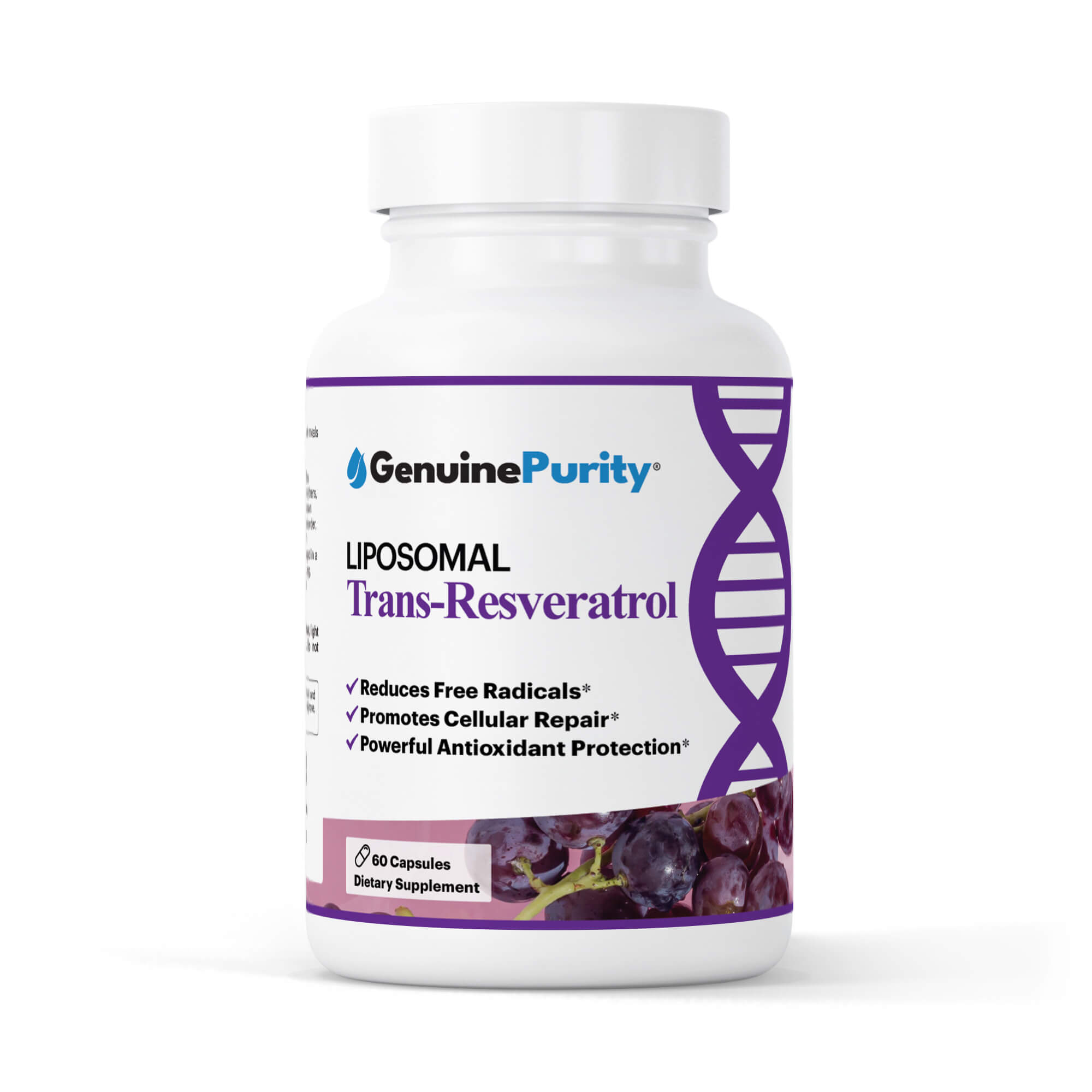
What to look for: the word "trans" attached to a percentage. Resveratrol's active isomer is the trans form; a label that gives a milligram amount without a trans purity percentage has told you the weight of an extract, not the weight of the active. GenuinePurity Resveratrol: PARTIAL — the check it fails against itself. A purity figure is stated, which already puts it ahead of most of the shelf — but the maker's store page says 99% pure while its own product landing page headlines 98% pure. Both numbers are the maker's. Neither is hidden; they simply disagree, and the maker has not reconciled them. A stated-but-conflicted percentage outranks a missing one, but only just — and it is the first thing a rival could beat this product on by printing one number and meaning it.
Check 2: Is the Dose Per Serving Unambiguous?
What to look for: milligrams per daily serving, with the serving defined in capsules — not a per-container total, and not a figure that changes meaning depending on which line you read. GenuinePurity Resveratrol: PASS, with a blemish. The dose is 500 mg of trans-resveratrol per daily serving, two capsules, and the maker's own blog confirms that reading explicitly. The blemish: on the store page, the "500mg" figure sits under a sentence beginning "Each capsule of Liposomal Trans-Resveratrol provides you with clinically studied doses…" — a careless read gives 500 mg per capsule, double the real dose. The correct reading is documented and consistent everywhere else; the sentence that invites the wrong one should not exist. When you run this check elsewhere, treat any dose you have to reconstruct as a dose the maker has not really published.
Check 3: Is the Source Named?
What to look for: the plant the resveratrol was extracted from, named on the label or product page. GenuinePurity Resveratrol: PASS. The active is listed as trans-resveratrol from Polygonum cuspidatum — Japanese knotweed root extract. A named source is a small line with a large implication: it tells you the maker is describing a specific extract with a specific origin, the kind a lab certificate can be issued against, rather than a generic powder bought on specification.
Check 4: Is the Full Capsule Published, With No Proprietary Blend?
What to look for: every ingredient, active and inactive, with the active's amount stated. A "proprietary blend" line is this check failed by design. GenuinePurity Resveratrol: PASS. One active at a stated 500 mg, and the rest of the capsule published in full: Vegetable Cellulose (Capsule), Microcrystalline Cellulose, Phospholipid Complex (Sunflower Lecithin, Phosphatidylcholine), Silicon Dioxide, Vegetable Stearate. There is nothing in this bottle a buyer cannot read — which is precisely what makes its one inconsistency, the purity figure, so noticeable.
Check 5: Is There a Third-Party Testing Policy You Can Point To?
What to look for: a stated policy of independent lab testing, ideally with Certificates of Analysis (COAs) the maker publishes or will produce. GenuinePurity Resveratrol: PASS, as stated. The maker states its products are tested and certified by third-party laboratories, publishes COAs on its site, and itself advises buyers to see a COA before purchasing any supplement — advice we endorse and apply to its own products first. Note the limit of this check: it verifies that a testing policy exists in writing. Reading the actual certificate for the batch in your hand is the buyer's final step, and the maker's own wording invites it.
Check 6: Is the Delivery Claim Checkable?
What to look for: if a product advertises a delivery technology — liposomal, phytosome, enhanced-absorption — the system should be identifiable in the ingredient list, and any performance figure should be printed. GenuinePurity Resveratrol: PARTIAL. The liposomal claim is checkable in its first half: the phospholipid complex is right there in the published contents. Its second half is empty: the maker publishes no absorption percentage and no delivery study for this product, so the size of the claimed advantage is unmeasured in print. A delivery claim with the system on the label and no numbers behind it is a partial pass — better than an unnamed "enhanced" formula, short of a demonstrated one.
Check 7: Is the Guarantee Written Down, and How Long Is It?
What to look for: a money-back guarantee with its length and terms in writing — and a window long enough to judge a slow category fairly. GenuinePurity Resveratrol: PASS. 97 days, 100% satisfaction, with the maker stating it refunds the full purchase price for up to two opened bottles and any unopened ones. That is the longest guarantee structure in our catalog, and for a product whose maker publishes no results timeline of its own, the guarantee window is the judging window — 97 days is a genuinely usable one.
Check 8: Can You Find the Safety Guidance?
What to look for: named cautions — pregnancy, medication, conditions — attached to the product or at least published by the maker. GenuinePurity Resveratrol: PARTIAL. The guidance exists and is real: the maker's blog states that pregnant or breastfeeding women, children, and people with certain health conditions should consult a healthcare provider first, and that people on medication — especially blood thinners — should seek medical advice. But it lives on the blog. The product page itself carries almost nothing beyond "(Or as directed by a health professional)." Guidance a buyer has to go hunting for is better than none, and worse than guidance on the page where the buying happens.
These statements have not been evaluated by the Food and Drug Administration. This product is not intended to diagnose, treat, cure, or prevent any disease.
The Scorecard
GenuinePurity Resveratrol against the eight checks: trans percentage — partial (stated, self-conflicted); dose per serving — pass with a blemish; source — pass; full capsule, no blend — pass; testing policy — pass as stated; delivery claim — partial (system disclosed, performance unpublished); guarantee — pass, at 97 days; safety guidance — partial (published, but on the blog). Five passes, three partials, no outright fails — a strong label by this category's standards, which is what our 7.5/10 records. Run the checks in order on any rival: the first two alone eliminate most of the shelf, because a label that cannot state its active percentage and its dose unambiguously has nothing underneath worth pricing.
Frequently Asked Questions
What purity should I look for in resveratrol? A stated trans-resveratrol percentage — and one figure, consistently used. The product we sell states 99% on its store page and 98% in its landing-page headline; we record the conflict rather than choose, and it is the clearest example in this guide of why consistency, not the number itself, is the check.
Is a higher milligram amount always better? Only if it is the same measurement. 500 mg of a stated-purity trans-resveratrol is a checkable claim; "1,000 mg resveratrol complex" with no trans percentage is a larger number carrying less information. Compare active milligrams at stated purity, per daily serving, or do not compare at all.
Does the guarantee length really matter? In this category, yes: resveratrol is a slow, subjective purchase, and the guarantee is the only trial protection a buyer gets. At $59 for one bottle — $53 per bottle in the three-bottle pack, $43 in the six-bottle pack, $39 on subscription — the 97-day window is what makes the premium end of this maker's pricing testable rather than a leap.
The Bottom Line
Buy resveratrol at the label, in this order: trans percentage, dose per serving, source, full contents, testing policy, delivery evidence, guarantee, safety guidance. The product we sell — full audit on the GenuinePurity Resveratrol page — passes most of that list and argues with itself on the first item, which tells you two things at once: the checks work, and almost nobody passes all of them. A rival that does would earn the shelf space. Until then, the checks are the product's real competition.
Disclaimer: This guide is for general information only and is not medical advice. Always consult a qualified healthcare professional before starting any supplement, especially if you have a medical condition or take prescription medication — the maker's own guidance singles out blood thinners in particular.
Last reviewed: October 2026